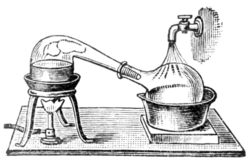
蒸留(distillation)とは、2種類以上の化学的に異なる物質が混ざり合った液体混合物を、それぞれの沸点の違いを利用して分離する手法です。液体を加熱して気化させ、その蒸気を再び冷却して液体に戻すことで、特定の成分を高純度で抽出することが可能です。
このプロセスは、物質ごとの「相対揮発度」の差を利用しています。揮発性の高い成分ほど先に蒸気となりやすいため、これを効率的に回収することで分離を実現します。現代では、香料の抽出から石油精製、アルコール飲料の製造まで、極めて幅広い分野で不可欠な技術となっています。
Key Facts
- 基本原理: 混合液を沸騰させ、発生した蒸気を凝縮させることで成分を分離する。
- エネルギー消費: 相変化(液体⇔気体)を伴うためエネルギー消費が激しく、産業用エネルギー全体の約25%を占めるとされる。
- 圧力範囲: 0.14 barから21 barという広範な圧力条件下で運用される。
- 多様な手法: 単純蒸留、分留、真空蒸留、水蒸気蒸留など、目的や物質の性質に応じて使い分けられる。
蒸留の歴史的変遷
古代から中世の黎明期
蒸留の起源は非常に古く、紀元前1200年頃のアッカド語の粘土板には、メソポタミアのバビロニア人が香水製造に原始的な蒸留を用いていた記録が残っています。古代ギリシャではアリストテレスが海水の蒸発による淡水化に言及し、200年頃にはアレクサンドリアの化学者たちが蒸留水の利用を記述していました。
![Distillation equipment used by the 3rd-century alchemist Zosimos of Panopolis[13][14] (as imagined by the anonymous illustrator of the 15th-century Byzantine Greek manuscript Codex Parisinus graecus 2327).[15]](/images/c5/34/c534fd8a031bd1c97438613c2e09dca3cd92006019dfdd8333bda8a6ec82a69e.jpg)
その後、イスラム黄金時代にはジャビル・イブン・ハイヤーンやアル・ラーズィーといった化学者が、有機物質の分留など高度な実験を行いました。彼らの研究は後にラテン語に翻訳され、ヨーロッパの錬金術に多大な影響を与えました。また、ワインからのエタノール抽出(燃える水)の技術もこの時期に発展し、13世紀末には西欧の化学者の間で広く知られるようになりました。
近代的な技術への進化
16世紀に入ると、ドイツのヒエロニムス・ブルンシュヴィヒが世界初の蒸留専門書を出版し、体系的な知識の普及が進みました。初期の蒸留は一度の加熱と冷却を繰り返す「バッチ式」が主流で、高純度を得るために数百回もの反復操作が行われることもありました。
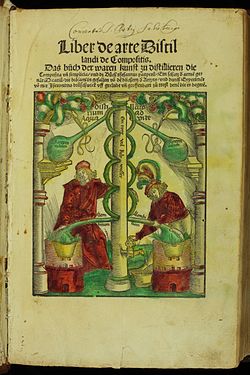
19世紀になると、予熱や還流(リフラックス)といった現代的な概念が登場します。1830年代にはエネアス・コフィーが連続式蒸留器を開発し、これが現代の石油化学プラントの原型となりました。20世紀には、マッケーブ・ティーレ法やフェンスケ式などの設計理論が確立され、経験則ではなく科学的な計算に基づいた効率的な設計が可能となりました。
蒸留の主要な種類と手法
研究室レベルの基本手法
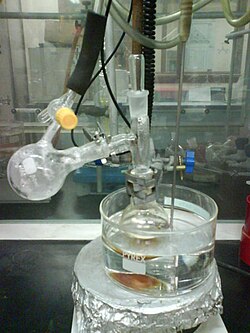
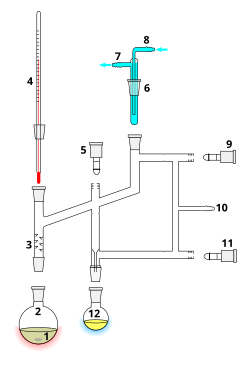
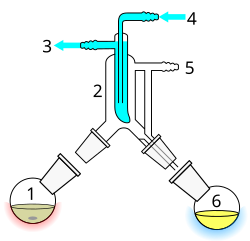
単純蒸留は、沸点差が十分に大きい(目安として25℃以上)液体同士の分離や、非揮発性の固体から液体を分ける際に用いられます。装置はシンプルで、加熱フラスコ、冷却管(コンデンサー)、回収フラスコで構成されます。
![Laboratory model of a still.1: The heat source to boil the mixture2: round-bottom flask containing the mixture to be boiled3: the head of the still4: mixture boiling-point thermometer5: the condenser of the still6: the cooling-water inlet of the condenser7: the cooling-water outlet of the condenser8: the distillate-receiving flask9: vacuum pump and gas inlet10: the receiver of the still11: the heat control for heating the mixture12: stirring mechanism speed control13: stirring mechanism and heating plate14: heating bath (oil/sand) for the flask15: the stirring mechanism (not shown, e.g. boiling chips or mechanical stirring machine)16: the distillate-cooling water bath.[1]: 141–143](/images/70/06/7006655a8d84902864ac7ab357d1429872434bc02b1be04f6de62320cee3293e.webp)
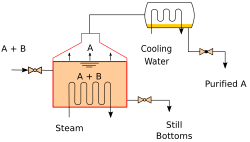
一方、沸点差が小さい成分を分離する場合は、分留(fractional distillation)が行われます。分留塔を用いることで、蒸発と凝縮を何度も繰り返させ、より純度の高い成分を上部に集めることができます。
特殊な蒸留プロセス
- 真空蒸留: システム内部の圧力を下げることで、物質の沸点を低下させる手法です。熱に弱い物質の分解を防ぐために利用されます。
- 分子蒸留: 0.01 torr以下の極高真空下で行われる蒸留です。流体力学ではなく分子動力学が支配的となり、非常に短い経路で凝縮させることでオイルなどの精製に用いられます。
- 水蒸気蒸留: 水蒸気を一緒に通すことで、高温での分解を避けつつ揮発性成分を抽出します。
- 乾留: 固体物質を加熱してガスを発生させ、それを凝縮させて液体や固体を得る手法(熱分解やクラッキングを含む)です。
産業規模での運用と課題
蒸留塔の構造と設計
工業的な蒸留は、高さ数メートルから90メートルに及ぶ巨大な円筒形の蒸留塔(精留塔)で行われます。塔の内部には「トレイ(棚段)」や「充填物(パッキング)」が設置されており、上昇する蒸気と下降する液体が効率的に接触して物質交換が行われます。
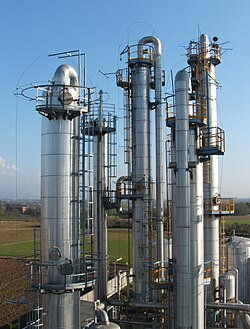
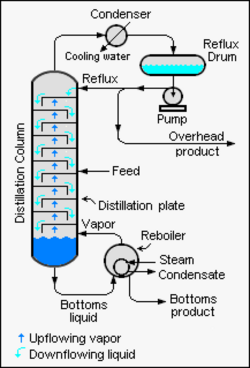
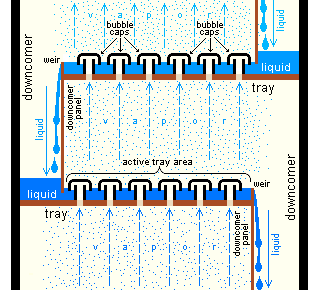
原油の精製のように多成分を含む混合物を扱う場合は、塔の異なる高さから異なる沸点範囲の成分(留分)を抜き出すことで、ガソリン、灯油、軽油などを同時に分離します。
![Large-scale, industrial vacuum distillation column[51]](/images/ec/03/ec03c12fc4978d49188eee9662d1bd2f02ae4c3131266e86780b3a043a4e80b9.jpg)
共沸点という壁
蒸留において困難なのが共沸(azeotrope)です。特定の組成になると、液体と蒸気の組成が等しくなり、単純な蒸留ではそれ以上の純度向上ができなくなります。例えば、エタノールと水の混合物は質量比95.6%で共沸し、これ以上の濃縮には圧力を変化させる「圧力スイング蒸留」などの特殊な手法が必要です。
蒸留プロセスのまとめ
| 手法 | 主な特徴 | 主な用途 |
|---|---|---|
| 単純蒸留 | 沸点差が大きい場合に有効 | 溶媒除去、単純分離 |
| 分留 | 分留塔で繰り返し凝縮・蒸発 | 原油精製、高純度化学品 |
| 真空蒸留 | 減圧により沸点を低下させる | 熱不安定物質の精製 |
| 分子蒸留 | 極高真空・短経路での分離 | 高粘度オイルの精製 |
| 乾留 | 固体を加熱しガス化 | 炭化、化学クラッキング |
Frequently Asked Questions
蒸留と単なる蒸発は何が違うのですか?
蒸発は液体表面から気体になる現象を指しますが、蒸留は「蒸発させた後にその蒸気を冷却して再び液体に戻す(凝縮)」というプロセスを含みます。これにより、特定の成分だけを分離して回収することが可能になります。
なぜ真空蒸留を行う必要があるのですか?
多くの化学物質は、本来の沸点まで加熱すると熱分解して壊れてしまいます。真空状態で圧力を下げると沸点が下がるため、物質を壊さない低い温度で蒸留を行うことができます。
共沸とは具体的にどのような状態ですか?
液体を沸騰させたとき、出てくる蒸気の組成が元の液体の組成と全く同じになってしまう状態です。この状態になると、どれだけ蒸留を繰り返しても組成が変わらず、純度を上げることができなくなります。
産業用蒸留塔の中で何が起きているのですか?
塔の下から加熱された蒸気が上がり、上から液体が降りてきます。トレイや充填物があることで、蒸気と液体が激しく接触し、沸点の低い成分が蒸気側へ、高い成分が液体側へと移動し続けることで、上に行くほど純度の高い成分が集まる仕組みになっています。
蒸留の環境負荷が高いと言われる理由は?
液体を気体に変える「相変化」には膨大な潜熱(エネルギー)が必要です。大規模なプラントで大量の液体を絶えず沸騰させ続けるため、産業全体のエネルギー消費量において非常に大きな割合を占めています。
References
- Harwood, Laurence M.; Moody, Christopher J. (1 January 1990), Experimental Organic Chemistry: Principles and Practice (Illustrated ed.), Blackwell Scientific Publications, 1854286W, Q107313989, retrieved 22 June 2021 – via
- J. D. Seader, E. J. Henley and D. K. Roper, Separation Process Principles, Wiley, 3rd edn, 2011.
- D. S. Sholl and R. P. Lively, Nature, 2016, 532, 435–437.
- Schaschke, C., 2014. A Dictionary of Chemical Engineering. Oxford University Press.
- 2019. Distillation: The Historical Symbol of Chemical Engineering. The University of Toledo. URL https://www.utoledo.edu/engineering/chemical-engineering/distillation.html Archived 14 April 2021 at the
- 2017. Products made from petroleum. Ranken Energy Corporation. URL https://www.ranken-energy.com/index.php/products-made-from-petroleum/ Archived 16 April 2021 at the
- Levey, Martin (1959). Chemistry and Chemical Technology in Ancient Mesopotamia. . p. 36.
As already mentioned, the textual evidence for Sumero-Babylonian distillation is disclosed in a group of Akkadian tablets describing perfumery operations, dated ca. 1200 B.C.
- Fairley, T. (1907). "The Early History of Distillation". Journal of the Institute of Brewing. 13 (6): 559–582. :10.1002/j.2050-0416.1907.tb02205.x.
- Kockmann, Norbert (2014). "History of Distillation". In Andrzej, Górak; Sorensen, Eva (eds.). Distillation: Fundamentals and Principles. Academic Press. pp. 1–43. :10.1016/B978-0-12-386547-2.00001-6. .
- Forbes, R. J. (1948) [Reprinted 1970]. A Short History of the Art of Distillation: From the Beginnings Up to the Death of Cellier Blumenthal. . p. 15. .
{{}}: ISBN / Date incompatibility ()
📸 フォトギャラリー