私たちの体には、外部から侵入した異物を検知し、免疫系に知らせる「監視役」が存在します。それが樹状細胞(Dendritic Cell: DC)です。その名の通り、木の枝のような突起を持つこの細胞は、哺乳類の免疫システムにおいて極めて重要な抗原提示細胞として機能しています。
樹状細胞の最大の使命は、ウイルスや細菌などの抗原(異物)を処理し、それをT細胞に提示することです。これにより、即座に反応する「自然免疫」と、特定の敵を記憶して攻撃する「獲得免疫」の間を繋ぐメッセンジャーとしての役割を果たしています。
Key Facts
- 主要機能:抗原を処理してT細胞に提示し、適応免疫応答を誘導する。
- 細胞形態:表面積が非常に大きく、効率的に周囲の環境をサンプリングできる。
- 主要な分類:cDC(従来型樹状細胞)とpDC(プラズマサイトイド樹状細胞)に大別される。
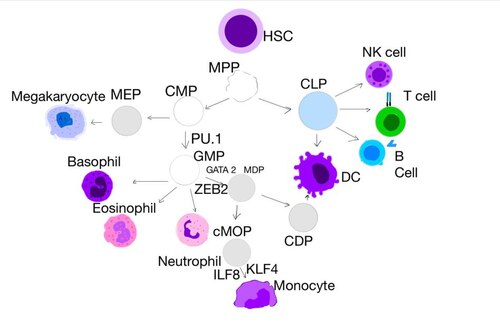
- 発生源:骨髄の造血幹細胞(HSC)から分化して生成される。
- 医学的意義:がん免疫療法やワクチン開発の鍵となる細胞である。
樹状細胞の種類と特徴
樹状細胞は、その形態的特徴から体積に対して非常に大きな表面積を持っており、効率的な抗原捕捉が可能です。霊長類においては、主に以下の2つのグループに分類されます。
従来型樹状細胞 (cDC)
単球に似た性質を持つ細胞で、さらに2つのサブセットに分かれます。cDC-1は主に細胞傷害性T細胞を刺激し、cDC-2はヘルパーT細胞を活性化させます。主にインターロイキン12 (IL-12) やIL-6、TNFなどのサイトカインを分泌し、TLR2やTLR4といった受容体を備えています。
プラズマサイトイド樹状細胞 (pDC)
外見は形質細胞に似ていますが、大量のインターフェロンα(IFN-α)を産生できる能力を持っており、かつては「インターフェロン産生細胞」と呼ばれていました。TLR7やTLR9を介して反応します。
血液中では、CD1c+、CD141+、CD303+といったマーカーを用いてこれらの細胞を識別します。血中の樹状細胞は組織内のものに比べて未熟で突起を持ちませんが、ケモカイン産生やクロスプレゼンテーションなどの重要な機能を保持しています。
発生プロセスとライフサイクル
樹状細胞は骨髄の造血幹細胞から生まれ、まずは「未熟樹状細胞」となります。この段階の細胞は、エンドサイトーシス(細胞外物質の取り込み)能力が高く、常に周囲に病原者がいないか監視しています。この際、 Toll様受容体 (TLR) などのパターン認識受容体を用いて、病原者特有の化学的サインを検知します。
抗原を捕捉すると、細胞は「成熟樹状細胞」へと変化し、リンパ節へと移動を開始します。成熟過程で、取り込んだタンパク質を分解し、MHC分子を用いて細胞表面に提示します。同時に、T細胞を活性化させるための共刺激分子(CD80, CD86, CD40)や、移動を促す受容体CCR7の発現を高めます。
リンパ節に到達した樹状細胞は、ナイーブT細胞(まだ抗原に出会っていないT細胞)に抗原を提示し、ヘルパーT細胞やキラーT細胞を活性化させます。また、状況に応じて免疫寛容(過剰な反応を抑えること)を誘導する場合もあります。
臨床的意義と疾患への関わり
がん治療への応用
腫瘍部位に樹状細胞が多く存在することは、一般的に良好な予後と関連しています。樹状細胞はT細胞を活性化して腫瘍の増殖を抑制できるため、樹状細胞を用いたワクチンや、免疫チェックポイント阻害剤(anti-PD-1など)との併用療法が研究されています。
ウイルス感染とHIV
HIVは、樹状細胞上のDC-SIGNなどの受容体を介して細胞内に侵入します。樹状細胞がウイルスを保持したままリンパ節へ移動することで、結果的にヘルパーT細胞へウイルスを受け渡し、感染を拡大させる経路となることが知られています。
稀少疾患:pDC腫瘍
プラズマサイトイド樹状細胞ががん化する「芽球性プラズマサイトイド樹状細胞腫瘍」という稀な血液がんが存在します。皮膚に結節や潰瘍が現れることが多く、骨髄や中枢神経系に浸潤することもあり、再発率が高く予後が厳しい疾患です。
樹状細胞の概要まとめ
| 項目 | 従来型樹状細胞 (cDC) | プラズマサイトイド樹状細胞 (pDC) |
|---|---|---|
| 主な形態的特徴 | 単球に類似 | 形質細胞に類似 |
| 主要な分泌物 | IL-12, IL-6, TNF | インターフェロンα (IFN-α) |
| 主要なTLR受容体 | TLR2, TLR4 | TLR7, TLR9 |
| 主な役割 | T細胞の強力な活性化 | 抗ウイルス応答の誘導 |
Frequently Asked Questions
樹状細胞とマクロファージの違いは何ですか?
どちらも抗原提示細胞ですが、樹状細胞は特に「ナイーブT細胞」を活性化させる能力に長けており、獲得免疫を始動させる能力において最も強力な細胞です。マクロファージは主に異物の除去(貪食)に特化しています。
樹状細胞はどこで生成されますか?
主に骨髄にある造血幹細胞から分化して生成されます。その後、血液を介して全身の組織やリンパ器官へと配置されます。
「抗原提示」とは具体的に何をすることですか?
取り込んだ病原体(抗原)を細胞内で分解し、その断片をMHCという分子に乗せて細胞表面に掲げることです。これにより、T細胞が「敵が侵入した」ことを認識できるようになります。
樹状細胞は人間以外にも存在しますか?
はい。哺乳類以外にも、カメやニジマス、ゼブラフィッシュなどの魚類でも樹状細胞のような細胞が確認されており、脊椎動物に広く見られる免疫機構であると考えられています。
References
- Monga I, Kaur K, Dhanda S (March 2022). "Revisiting hematopoiesis: applications of the bulk and single-cell transcriptomics dissecting transcriptional heterogeneity in hematopoietic stem cells". Briefings in Functional Genomics. 21 (3): 159–176. :10.1093/bfgp/elac002. 35265979.
- Steinman, R. M.; Cohn, Z. A. (1973). "Identification of a Novel Cell Type in Peripheral Lymphoid Organs of Mice : I. Morphology, Quantitation, Tissue Distribution". The Journal of Experimental Medicine. 137 (5): 1142–1162. :10.1084/jem.137.5.1142. 2139237. 4573839.
- Banchereau J, (March 1998). "Dendritic cells and the control of immunity". Nature. 392 (6673): 245–52. :1998Natur.392..245B. :10.1038/32588. 9521319. 4388748.
- "The Lasker Foundation – 2007 Awards". Retrieved 27 November 2010.
- "Nobel Prize in Physiology or Medicine for 2011".
- Sallusto F, Lanzavecchia A (2002). "The instructive role of dendritic cells on T-cell responses". Arthritis Res. 4 (Suppl 3): S127–32. :10.1186/ar567. 3240143. 12110131.
- McKenna K, Beignon A, Bhardwaj N (2005). "Plasmacytoid Dendritic Cells: Linking Innate and Adaptive Immunity". 79 (1): 17–27. :10.1128/JVI.79.1.17-27.2005. 538703. 15596797.
- Vanbervliet B, Bendriss-Vermare N, Massacrier C, et al. (September 2003). "The Inducible CXCR3 Ligands Control Plasmacytoid Dendritic Cell Responsiveness to the Constitutive Chemokine Stromal Cell–derived Factor 1 (SDF-1)/CXCL12". J. Exp. Med. 198 (5): 823–30. :10.1084/jem.20020437. 2194187. 12953097.
- Liu YJ (2005). "IPC: professional type 1 interferon-producing cells and plasmacytoid dendritic cell precursors". Annu. Rev. Immunol. 23 (1): 275–306. :10.1146/annurev.immunol.23.021704.115633. 15771572.
- Dzionek A, Fuchs A, Schmidt P, Cremer S, Zysk M, Miltenyi S, Buck D, Schmitz J (2000). "BDCA-2, BDCA-3, and BDCA-4: three markers for distinct subsets of dendritic cells in human peripheral blood" (PDF). J Immunol. 165 (11): 6037–46. :10.4049/jimmunol.165.11.6037. 11086035. 22459468.
📸 フォトギャラリー