地球上の生命の歴史において、最も重要な役割を果たした微生物の一つがシアノバクテリアです。かつては「藍藻」と呼ばれ、藻類の一種と考えられていましたが、実際には細菌(バクテリア)の一群であり、光合成によって酸素を放出する能力を持っています。彼らが数億年前に大気中に酸素を供給したことで、その後の複雑な多細胞生物の進化が可能となりました。
シアノバクテリアは、海洋から淡水、さらには極限環境まで、地球上のほぼあらゆる場所に生息しています。海水の飛沫と共に大気高くへと運ばれ、「エアロプランクトン」として世界中を旅することさえあります。
![Cyanobacteria are found almost everywhere. Sea spray containing marine microorganisms, including cyanobacteria, can be swept high into the atmosphere where they become aeroplankton, and can travel the globe before falling back to earth.[20]](/images/18/e3/18e34c092d53edbcca57bb991a730a5a8aa71c83d1fabefecb08d42692e1fa39.jpg)
Key Facts
- 光合成の先駆者: 水を分解して酸素を生成する酸素発生型光合成を行う細菌。
- 地球環境の形成: 太古の地球に酸素を供給し、現在の呼吸可能な大気を作り出した。
- 多様な形態: 単細胞から、糸状のコロニーを形成するものまで幅広い形態を持つ。
- 窒素固定能力: 大気中の窒素を生物が利用可能な形に変えることができ、生態系の栄養源となる。
- 葉緑体の起源: 真核生物の葉緑体は、シアノバクテリアが細胞内に共生したことで誕生したとされる。
シアノバクテリアの形態と細胞構造
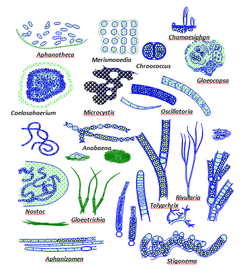
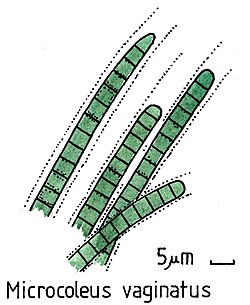
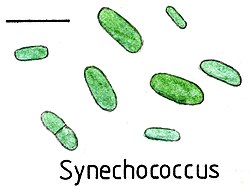
シアノバクテリアの形態は非常に多様です。単純な単細胞のものから、細胞が連なって長い鎖状になる糸状種まで存在します。特に糸状種の中には、環境に応じて役割の異なる特殊な細胞を分化させる能力を持つものがいます。
- 栄養細胞: 通常の条件下で光合成を行う標準的な細胞。
- アキネート(休眠胞子): 環境が悪化した際に形成される、耐性の高い胞子状の細胞。
![Morphological variations:[56] Unicellular: (a) Synechocystis and (b) Synechococcus elongatusNon-heterocytous: (c) Arthrospira maxima,(d) Trichodesmium and (e) PhormidiumFalse- or non-branching heterocytous: (f) Nostoc and (g) Brasilonema octagenarumTrue-branching heterocytous: (h) Stigonema (ak) akinetes (fb) false branching (tb) true branching](/images/45/44/4544e9f6a5341198c96569a79e155b153ddd11b53d295525730605226904dd89.jpg)
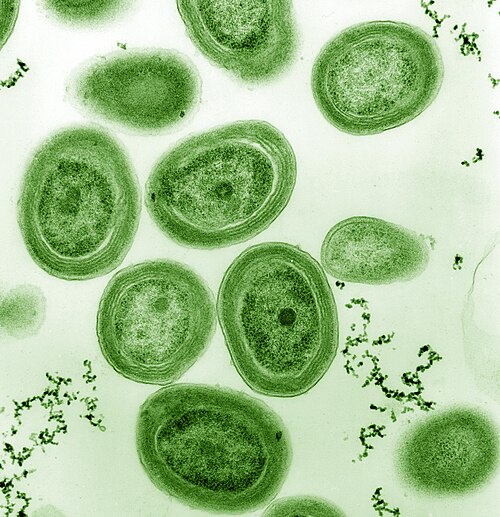
細胞内部に目を向けると、光合成を行うためのチラコイド膜という特殊な膜構造が発達しています。また、二酸化炭素を固定するためのカルボキシソームや、エネルギー貯蔵のためのグリコーゲン顆粒などが配置されており、効率的な代謝システムを構築しています。
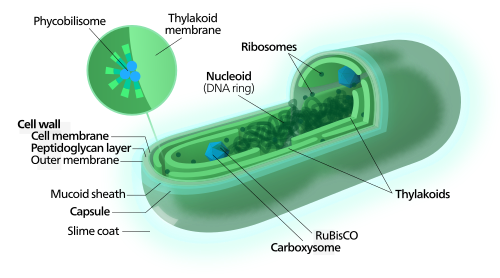
![Cyanobacterial thylakoid membrane [66] Outer and plasma membranes are in blue, thylakoid membranes in gold, glycogen granules in cyan, carboxysomes (C) in green, and a large dense polyphosphate granule (G) in pink](/images/da/35/da35c6c7325d537b8018abab3370b98dd3a9babe424a2e8b2085ca4bd52e60db.png)
生態学的役割と生存戦略
シアノバクテリアは、水圏生態系の基盤となる一次生産者です。特に海洋においては、プロクロロコッカスのような微小な種が、地球全体の酸素生産の大部分を担っています。
また、一部の種は窒素固定という高度な能力を持っており、大気中の窒素ガスをアンモニアに変換して土壌や水中に供給します。これにより、他の植物や微生物の成長を助ける重要な役割を果たしています。
共生と集団行動
彼らは単独で生きるだけでなく、他の生物と密接な共生関係を築くことがあります。陸上植物の根や葉に定着して栄養を供給したり、渦鞭毛藻などの原生生物の細胞内に共生したりすることが知られています。
![Symbiosis with land plants [110]Leaf and root colonization by cyanobacteria (1) Cyanobacteria enter the leaf tissue through the stomata and colonize the intercellular space, forming a cyanobacterial loop. (2) On the root surface, cyanobacteria exhibit two types of colonization pattern; in the root hair, filaments of Anabaena and Nostoc species form loose colonies, and in the restricted zone on the root surface, specific Nostoc species form cyanobacterial colonies. (3) Co-inoculation with 2,4-D and Nostoc spp. increases para-nodule formation and nitrogen fixation. A large number of Nostoc spp. isolates colonize the root endosphere and form para-nodules.[110]](/images/d2/2b/d22bfb029f7d8cf2e08bcb7ec41fc86354d02fdf7205cf47d679791139164fe6.jpg)
![Cyanobionts of Ornithocercus dinoflagellates [111] Live cyanobionts (cyanobacterial symbionts) belonging to Ornithocercus dinoflagellate host consortium(a) O. magnificus with numerous cyanobionts present in the upper and lower girdle lists (black arrowheads) of the cingulum termed the symbiotic chamber.(b) O. steinii with numerous cyanobionts inhabiting the symbiotic chamber.(c) Enlargement of the area in (b) showing two cyanobionts that are being divided by binary transverse fission (white arrows).](/images/aa/46/aa4618b3bf56c3b204ea31e6c5fac7b73f0add62e623f1d6585aa541f83b16c2.png)
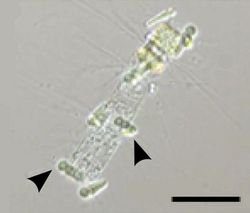
さらに、単細胞種であっても集団で行動し、浮力を調節して最適な光環境へ移動したり、微生物マットと呼ばれる厚い層を形成して過酷な環境を生き抜いたりする戦略を持っています。
![Collective behaviour and buoyancy strategies in single-celled cyanobacteria [132]](/images/b0/34/b0345838a2add7587819fd604ce0970751193e533b795998e2beeb7597704568.png)
![Model of a clumped cyanobacterial mat [135]](/images/ba/f8/baf8fcb357bd965c0801107599245520bf20df34c1476b166fac0895d23b31bf.png)
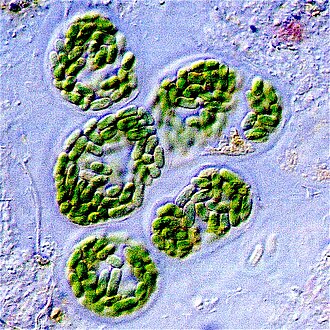
地球の歴史と進化への影響
シアノバクテリアの歴史は、地球の歴史そのものです。約21億年以上前から存在していたと考えられており、彼らによる光合成の結果、地球上に酸素が蓄積する「大酸化イベント」が引き起こされました。
![Timing and trends in cell diameter, loss of filamentous forms and habitat preference within cyanobacteria Based on data: nodes (1–10) and stars representing common ancestors from Sánchez-Baracaldo et al., 2015,[45] timing of the Great Oxidation Event (GOE),[215] the Lomagundi-Jatuli Excursion,[216] and Gunflint formation.[217] Green lines represent freshwater lineages and blue lines represent marine lineages are based on Bayesian inference of character evolution (stochastic character mapping analyses).[45] Taxa are not drawn to scale – those with smaller cell diameters are at the bottom and larger at the top](/images/35/6b/356bd0ce4b5ce00b79a8e27ea4fe225d0a6b7534863673184ed03b74b1b38b01.png)
この酸素の増加は、嫌気性生物には致命的でしたが、同時に酸素を利用して効率的にエネルギーを得る好気性生物の道を切り拓きました。また、ある種の真核細胞がシアノバクテリアを取り込んだことが、現代の植物が持つ葉緑体の始まりになったという「細胞内共生説」は、生物学の定説となっています。
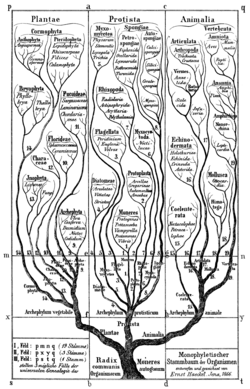
人間社会との関わり:利活用とリスク
シアノバクテリアは、現代社会においても様々な面で影響を与えています。農業分野では、窒素固定能力を利用して土壌を豊かにする天然の肥料として期待されています。
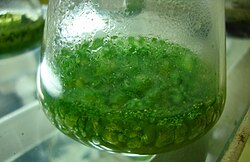
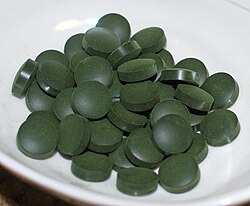
また、栄養価の高いスピルリナなどは、健康食品としてサプリメントに加工され、世界中で利用されています。
一方で、富栄養化が進んだ湖沼などで爆発的に増殖する「アオコ」は深刻な問題です。一部の種は強力な毒素(シアノトキシン)を産生し、魚類や家畜、そして人間の健康に悪影響を及ぼすことがあります。
![Environmental impact of cyanobacteria and other photosynthetic microorganisms in aquatic systems. Different classes of photosynthetic microorganisms are found in aquatic and marine environments where they form the base of healthy food webs and participate in symbioses with other organisms. However, shifting environmental conditions can result in community dysbiosis, where the growth of opportunistic species can lead to harmful blooms and toxin production with negative consequences to human health, livestock and fish stocks. Positive interactions are indicated by arrows; negative interactions are indicated by closed circles on the ecological model.[98]](/images/d0/e1/d0e1ff910e3bc8d8cf765e95dc23bc2a9ddc80f86dc4c07dc7dc2b5dd2c06a44.png)
細胞の死と制御
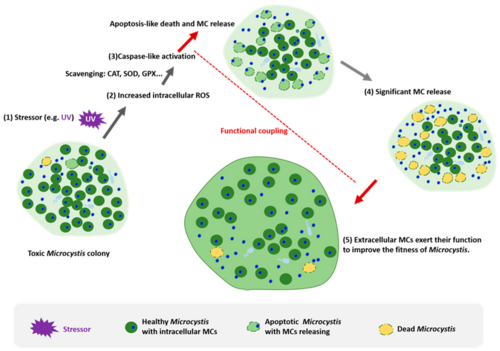
シアノバクテリアには、外部からの激しい損傷による「偶発的な細胞死(ACD)」だけでなく、遺伝的に制御された「調節性細胞死(RCD)」の仕組みがあることが示唆されています。これは、集団全体の生存率を高めるための戦略的な細胞死であると考えられています。
![Cell death in eukaryotes and cyanobacteria [27] Types of cell death according to the Nomenclature Committee on Cell Death (upper panel;[138] and proposed for cyanobacteria (lower panel). Cells exposed to extreme injury die in an uncontrollable manner, reflecting the loss of structural integrity. This type of cell death is called "accidental cell death" (ACD). "Regulated cell death (RCD)" is encoded by a genetic pathway that can be modulated by genetic or pharmacologic interventions. Programmed cell death (PCD) is a type of RCD that occurs as a developmental program, and has not been addressed in cyanobacteria yet. RN, regulated necrosis.](/images/a2/d4/a2d44b1c34f55dc858213a449beabe914bbb62d3ee23a9e37a89eb0d2db016d6.jpg)
また、彼らを標的とするウイルスである「シアノファージ」の存在は、個体数の爆発的な増加を抑制し、海洋の物質循環を維持する重要な制御因子となっています。
さらに、一部の種は滑走運動(グライディング)という特殊な移動手段を持ち、光や化学物質に反応して最適な場所へと移動します。
シアノバクテリアの概要まとめ
| 項目 | 特徴・詳細 |
|---|---|
| 分類 | 細菌ドメイン / シアノバクテリア門 (Cyanobacteriota) |
| 主な能力 | 酸素発生型光合成、窒素固定 |
| 形態 | 単細胞、糸状(栄養細胞、アキネートなどの分化あり) |
| 生息地 | 海洋、淡水、土壌、大気(エアロプランクトン) |
| 地球への貢献 | 大気への酸素供給、葉緑体の起源 |
| リスク | 有害藻類ブルーム(アオコ)による毒素産生 |
Frequently Asked Questions
シアノバクテリアは藻類(アルジー)なのですか?
見た目や光合成を行う点から、かつては藻類に分類されていましたが、細胞構造が原核生物(細菌)であるため、現在は細菌の一種として分類されています。
なぜシアノバクテリアが地球にとって重要なのですか?
彼らが太古の昔に光合成を行い、水から酸素を切り離して大気中に放出したことで、現在の酸素濃度が維持され、人間を含む好気性生物が生存できる環境が整ったためです。
アオコが発生するとどのような危険がありますか?
一部のシアノバクテリアは肝臓や神経に影響を与える毒素を産生します。これにより、飲用水の汚染や、家畜・魚類の大量死、皮膚炎などの健康被害を引き起こす可能性があります。
窒素固定とは具体的にどのような仕組みですか?
大気中に大量に存在する窒素ガス(N2)を、生物が吸収して利用できるアンモニアなどの形に変換することです。これにより、窒素が不足している環境でも生命が生存できるようになります。
スピルリナはシアノバクテリアの一種ですか?
はい、スピルリナはシアノバクテリアの一種であり、その高い栄養価から健康食品として広く利用されています。
References
- See note on .
- Some authors restrict the term to (), which does not extend to cyanobacteria, which are . However, the majority continue to refer to cyanobacteria as a type of algae.
📸 フォトギャラリー