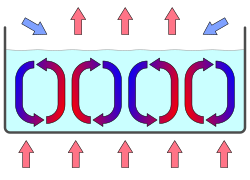
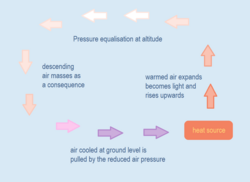
私たちの身の回りで起きている現象の多くは、目に見えない流体の動きによって制御されています。その代表的な仕組みが対流です。対流とは、液体や気体などの流体が物理的に移動することで熱が運ばれる現象を指します。一般的に、加熱されて密度が低くなった軽い物質が上昇し、逆に冷却されて密度が高くなった重い物質が下降することで、流体の中に循環が生まれます。
この現象は、単なる温度変化だけでなく、物質の組成による密度の違いや、重力、電磁気力などの外力によっても引き起こされます。対流は地球の内部から宇宙の星々に至るまで、極めて広範なスケールで重要な役割を果たしています。
Key Facts
- 基本原理:温度や組成の差による密度の不均一性と、重力などの外力が組み合わさることで発生する。
- 熱輸送:温かい流体は上昇し、冷たい流体は下降するという循環を通じて効率的に熱を運ぶ。
- 発生条件:密度差が大きいほど、また重力が強いほど、対流はより速く、起こりやすくなる。
- 抑制要因:流体の粘性が高い(ドロドロしている)場合や、拡散が速い場合は対流が抑制される。
- 判定指標:自然対流の開始は「レイリー数(Ra)」という無次元数によって数学的に定義される。
対流の種類と発生メカニズム
自然対流と強制対流
流体の動きが、密度差による浮力などの内部的な要因で自発的に起こるものを自然対流と呼びます。一方で、ポンプやファンなどの外部装置によって強制的に流体を動かす場合は強制対流と呼ばれます。この二つのどちらが支配的かは、リチャードソン数(グラショフ数とレイノルズ数の関係)によって判断されます。
温度以外の要因による対流
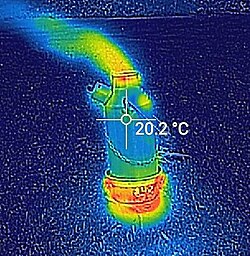
対流は必ずしも温度差だけで起こるわけではありません。物質の濃度勾配によって密度が変わることで発生するものは「溶質対流」と呼ばれます。例えば、湿った土壌に乾燥した塩が浸透し、塩水と淡水の密度差で流動が起きる現象などがこれにあたります。このような重力対流が起こるには、重力加速度が存在する環境が不可欠です。

特殊な条件下での挙動:水の密度異常
多くの流体は温度が上がると密度が下がりますが、水は例外的な挙動を示します。水は4℃で最大密度となるため、氷点に近い温度域では通常の熱膨張とは異なる複雑な循環パターンを描きます。また、凝固点以下になっても凍らない「過冷却」状態では、氷の核形成が遅れることで特有のプルーム(上昇・下降流)が発生します。
地球と宇宙における対流の具体例
大気と気象への影響
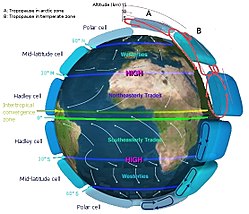
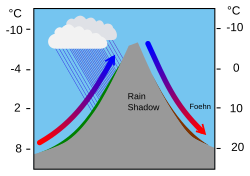
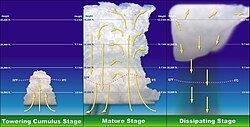
地球の大気では、対流が天候を決定づける主要な要因です。局所的な対流セルが発達すると積乱雲が形成され、激しい雷雨をもたらします。雷雨は一般的に「発達期」「成熟期」「消散期」という3つの段階を経て、平均30分ほどで変化します。また、地球規模の空気の動きである大気大循環や、山脈によるフェーン現象も対流の仕組みに基づいています。
海洋と地球内部のダイナミクス
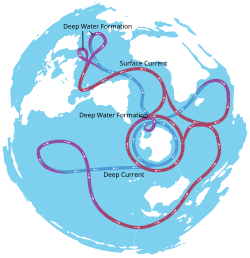
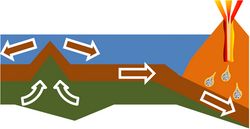
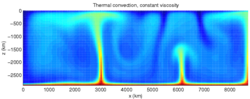
海洋では、温度と塩分濃度の違いによる密度差が深層海流を生み出します。さらに視点を地球内部へ移すと、岩石質のマントルが極めてゆっくりと対流していることが分かります。このマントル対流は、地表のプレートを動かす原動力の一つとなっており、地質学的な変動に直接関与しています。
恒星物理学における役割
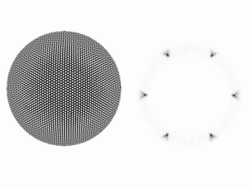
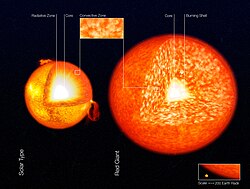
太陽などの恒星においても、対流はエネルギー輸送の重要な手段です。星の内部で放射よりも対流の方が効率的にエネルギーを運べる領域を「対流圏」と呼びます。太陽の表面に見られる粒状構造(グラニュレーション)は、プラズマの対流セルの頂上部分が可視化したものであり、一つ一つの粒の直径は約1,000kmに達します。
工学的応用と数学的モデル
原子力発電所での活用
安全設計が重視される原子炉では、ポンプが停止しても冷却材が流れ続ける「自然循環」が利用されます。熱源となる原子炉を冷却装置(ヒートシンク)よりも低い位置に配置することで、密度差による自然対流を誘発し、非常時の冷却を確保する設計が採用されています。
対流の定量化
対流の強さやパターンを解析するために、物理学ではいくつかの無次元数が用いられます。特に、浮力と粘性抵抗の比を示すレイリー数(Ra)は、対流がいつ始まるかを予測するために不可欠です。また、熱伝達率を評価するヌセルト数(Nu)や、慣性と粘性の比を示すグラショフ数(Gr)などが、流体の形状(垂直平板や円筒など)に応じて使い分けられます。
| 指標名 | 主な役割・意味 | 影響を与える要因 |
|---|---|---|
| レイリー数 (Ra) | 自然対流の開始条件の判定 | 密度差、重力、長さ、粘性、拡散率 |
| グラショフ数 (Gr) | 浮力と粘性力の比率を評価 | 温度差、重力、流体の粘性 |
| ヌセルト数 (Nu) | 対流熱伝達と純粋な伝導の比 | 流速、形状、熱伝導率 |
| リチャードソン数 | 自然対流と強制対流のどちらが支配的か | GrとRe(レイノルズ数)の比 |
Frequently Asked Questions
対流が起こるために絶対に必要な条件は何ですか?
大きく分けて2つの条件が必要です。一つは流体内部に「密度差」があること(温度差や濃度差によるもの)、もう一つはそれを方向付ける「外力(主に重力)」が存在することです。無重力空間では、温度差があっても通常の意味での自然対流は発生しません。
「自然対流」と「強制対流」の違いは何ですか?
自然対流は、流体自体の密度変化によって自発的に起こる流れです。一方、強制対流はファンやポンプなどの外部エネルギーを用いて意図的に流体を動かす流れを指します。例えば、暖かい部屋で自然に空気が上昇するのは自然対流であり、扇風機で風を送るのは強制対流です。
太陽の表面に見える「粒」は何ですか?
あれは「粒状構造(グラニュレーション)」と呼ばれるもので、太陽内部から表面へ向かうプラズマの対流セルの頂上部分です。中心の明るい部分は高温のプラズマが上昇している場所で、周囲の暗い部分は冷却されたプラズマが下降している場所に対応しています。
マントルは岩石なのに、なぜ対流できるのですか?
マントルを構成する岩石は、人間的な時間スケールでは固体ですが、数百万年という地質学的な時間スケールで見ると、非常にゆっくりと流動する性質(粘弾性)を持っています。このため、地球内部の熱によって極めて緩やかな対流が起こり、それがプレートテクトニクスの原動力となっています。
水の対流にはどのような特殊な点がありますか?
水は4℃で密度が最大になるという特異な性質を持っています。そのため、0℃から4℃の間では、温度が上がると逆に密度が高くなるため、通常の流体とは逆方向の対流が起こることがあります。これが冬の湖の底に水が溜まり、魚が生存できる環境を作る要因の一つとなっています。
References
- Prout, William. (1834). Chemistry, meteorology and the function of digestion: considered with reference to natural theology. The Bridgewater Treatises: On the power, wisdom and goodness of God as manifested in the creation. Treatise 8. William Pickering. pp. 65–66.
- Munson, Bruce R. (1990). Fundamentals of Fluid Mechanics. . .
- Falkovich, G. (2011). Fluid Mechanics, a short course for physicists. Cambridge University Press. . Archived from the original on 2012-01-20.
- Çengel, Yunus A.; Boles, Michael A. (2001). Thermodynamics:An Engineering Approach. . .
- ; Piro, Oreste; Villacampa, Ana I. (2002). "Pattern Formation in Solutal Convection: Vermiculated Rolls and Isolated Cells". Physica A: Statistical Mechanics and Its Applications. 314 (1): 291. :2002PhyA..314..291C. 10.1.1.15.8288. :10.1016/S0378-4371(02)01080-4.
{{}}: Cite uses deprecated parameter|citeseerx=() - Raats, P. A. C. (1969). "Steady Gravitational Convection Induced by a Line Source of Salt in a Soil". Soil Science Society of America Proceedings. 33 (4): 483–487. :1969SSASJ..33..483R. :10.2136/sssaj1969.03615995003300040005x.
- McKinnon, William B. (2006). "On convection in ice I shells of outer Solar System bodies, with detailed application to Callisto". Icarus. 183 (2): 435–450. :2006Icar..183..435M. :10.1016/j.icarus.2006.03.004.
- Convection Experiment - GCSE Physics, 12 December 2020, archived from the original on 2021-12-11, retrieved 2021-05-11
- Convection Experiment, archived from the original on 2021-12-11, retrieved 2021-05-11
- Convection Current Lab Demo, 29 September 2017, archived from the original on 2021-12-11, retrieved 2021-05-11
📸 フォトギャラリー