宇宙に浮かぶ星の周囲には、ガスや塵、小惑星などがリング状に集まった星周円盤(circumstellar disc)と呼ばれる構造が存在します。この円盤は、若い星にとっては惑星を形作るための「材料庫」であり、成熟した星にとっては過去に惑星形成が行われた証拠となります。また、白色矮星の周囲に見られる場合は、星の進化過程を生き延びた惑星物質の存在を示唆しています。
星周円盤は、その形態によってドーナツ状やパンケーキ状に見え、中心にある星の重力によって維持されています。これらの構造を詳しく解析することで、私たちは太陽系がどのように誕生し、他の星系がどのような道を辿るのかを理解することができます。
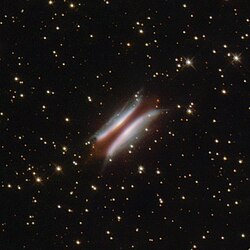
![Circumstellar discs HD 141943 and HD 191089. The bottom images are illustrations of above real images.[1]](/images/fb/dc/fbdcb6177c2862b33aba6ca77424bc6c20b1c010701a4002b38f2a02cf96c135.jpg)
Key Facts
- 惑星の起源: 若い星の周囲にあるガスと塵の円盤から惑星が形成される。
- 進化の段階: 原始惑星系円盤 → 遷移円盤 → デブリ円盤という段階を経て変化する。
- 連星系の多様性: 2つの星が回る系では、個別の星の周りや、2つの星を包み込む大きな円盤が形成される。
- 観測手法: 可視光・赤外線による散乱光の観測や、ALMAなどの電波干渉計によるミリ波観測が行われる。
星の誕生と原始惑星系円盤の形成
星の形成は、巨大分子雲の中にある物質が重力崩壊を起こすことから始まります(星雲説)。回転しながら中心に物質が集まる際、角運動量を持つため、中心の原始星を囲むようにガスと塵の平坦な円盤が形成されます。これが原始惑星系円盤(protoplanetary disc)です。
この円盤は主に水素ガスで構成されており、中心星の質量の数パーセントに相当する物質を含んでいます。数百万年にわたる集積段階を経て、円盤内の温度が下がると、岩石や氷の微小な粒子が凝集し、さらに大きな「微惑星」へと成長します。十分な質量があれば、これらが衝突・合体を繰り返して惑星の胚となり、最終的に惑星系が構築されます。太陽のような星の場合、このプロセスに約1億年かかると考えられています。
![Primordial cloud of gas and dust surrounding the young star HD 163296.[13]](/images/7b/7a/7b7aab2321b6b28c9eb8384a24b53ef01605781198b24455c6bf401ef0a28632.jpg)
![Protoplanetary disk AS 209.[15]](/images/f2/10/f210c0cfec90d557766d3c81ff04a14864c853a6193687e50cd077276fd840b0.jpg)
円盤の内部構造と境界線
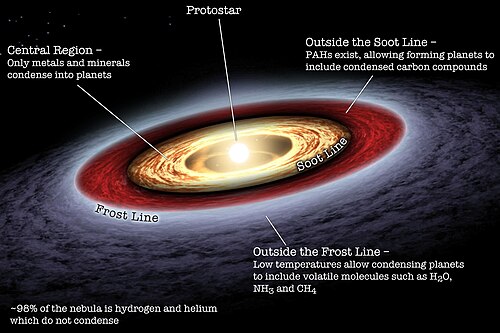
円盤内では、温度によって物質の状態が変わります。特に、特定の物質が凝固する境界である「スートライン(煤線)」や「フロストライン(凍結線)」が、形成される惑星の組成(岩石惑星かガス惑星か)を決定づける重要な要因となります。
星周円盤の進化ステージ
星周円盤は時間とともにその組成と構造を劇的に変化させます。主に以下の3つのステージに分類されます。
- 原始惑星系円盤: 大量のガスと塵が存在し、惑星形成のポテンシャルが最も高い段階。
- 遷移円盤(Transition discs): ガスや塵が大幅に減少し、内部に大きな穴が開いた状態。原始惑星系円盤からデブリ円盤への移行期にあたります。
- デブリ円盤(Debris discs): ガスがほとんど消失し、希薄な塵だけが残った状態。この塵は寿命が短いため、微惑星同士の衝突などによって絶えず供給される「二次的な塵」であると考えられています。
![Artist's impression of a transitional disc around a young star.[3]](/images/0e/d3/0ed336012fb43ee421e2be4f9cf39acdddec9e7cc29e668355b1c78516ae7500.jpg)
物質の消散プロセス
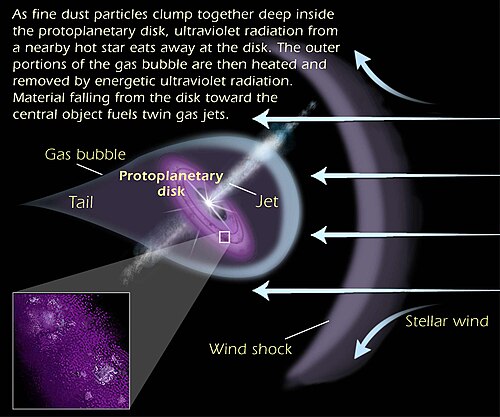
円盤から物質が失われる「消散」は、中心星からのX線や紫外線による光蒸発、粒子の成長による不透明度の低下、あるいは形成された巨大惑星による重力的影響など、複数のメカニズムによって進行します。消散は円盤の内側から外側へと段階的に進み、内側(0.1 AU未満)は非常に高温で近赤外線を放射し、外側(50〜100 AU)は極低温でミリ波領域の放射が見られます。
連星系における複雑な円盤構造
2つの星が互いの周りを回る連星系では、ガスが流入する際の角運動量に応じて、より複雑な円盤が形成されます。
- 主星周円盤(Circumprimary disc): より質量の大きい主星の周囲に形成される円盤。
- 伴星周円盤(Circumsecondary disc): 質量の小さい伴星の周囲に形成される円盤。高い角運動量がある場合にのみ形成されます。
- 周連星円盤(Circumbinary disc): 2つの星全体を包み込むように外側を回る円盤。
周連星円盤では、2つの星の重力相互作用(リンブラッド共鳴)によって、中心部に物質のない空洞(キャビティ)が必然的に形成されます。また、円盤の傾きがある場合、歳差運動によってX線放射が周期的に遮られる現象が見られることもあります。
観測技術と直接撮像
星周円盤の観測には、星の強い光を遮るコロナグラフや、大気の揺らぎを補正する補償光学(Adaptive Optics)が用いられます。円盤が地球から見て真横(エッジオン)を向いている場合、星の光が遮られて円盤そのものがシルエットのように見えることがあります。
また、ALMAのような電波干渉計を用いることで、円盤の中平面に存在するミリ波サイズの大きな塵の粒や、ガスの速度分布を詳細にマッピングすることが可能です。これにより、惑星が円盤に刻んだ「溝」などの構造を捉えることができます。
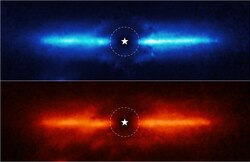
![Image of Fomalhaut's asteroid belt by the James Webb Space Telescope[17] with annotations by NASA.](/images/d4/aa/d4aa2c1a8d369fa9eb70dc89fb666e1e1973b221b39eb04e2ebd144fd9a1eb3d.png)
星周円盤の特性まとめ
| ステージ | 主な構成物質 | 特徴 | 主な観測波長 |
|---|---|---|---|
| 原始惑星系円盤 | 大量のガス・微小塵 | 惑星形成の初期段階、高質量 | 赤外線・ミリ波 |
| 遷移円盤 | 減少したガス・塵 | 中心部に空洞が存在する移行期 | 中赤外線 |
| デブリ円盤 | 希薄な塵(二次的) | ガスがほぼ消失、微惑星の衝突で維持 | 遠赤外線・サブミリ波 |
Frequently Asked Questions
星周円盤から惑星ができるまでどのくらい時間がかかりますか?
太陽のような星の場合、惑星系が形成されるまでに約1億年かかると考えられています。ただし、初期の集積段階(主 accretion phase)は数百万年という比較的短い期間で進行します。
デブリ円盤と原始惑星系円盤の違いは何ですか?
最大の違いはガスの量と塵の起源です。原始惑星系円盤は星誕生時のガスを大量に含んでいますが、デブリ円盤はガスがほぼなく、塵は微惑星同士の衝突によって後から生成されたものです。
連星系でも惑星は作られますか?
はい、作られます。主星や伴星の個別の円盤内、あるいは2つの星を囲む周連星円盤の中で惑星が形成される可能性があります。
どのようにして円盤の「穴」や「溝」を発見するのですか?
ALMAなどの高解像度電波望遠鏡を用いて、塵の密度分布を詳細に観測します。特定の領域で物質が欠落している場合、そこに巨大惑星が存在し、重力で周囲の物質を掃き出したと考えられます。
太陽系にも星周円盤の名残はありますか?
はい。火星と木星の間にある小惑星帯(アステロイドベルト)や、海王星の外側にあるエッジワース・カイパーベルト、散在円盤などが、かつての原始惑星系円盤の残骸にあたります。
References
- "Circumstellar Disks HD 141943 and HD 191089". ESA/Hubble images. Retrieved 29 April 2014.
- Hartmann, L; ; Gullbring, E; D’Alessio, P (1998). "Accretion and the Evolution of T Tauri Disks". The Astrophysical Journal. 495 (1): 385–400. :1998ApJ...495..385H. :10.1086/305277.
- "ALMA Reveals Planetary Construction Sites". Retrieved 21 December 2015.
- Bate, M; Bonnell, A (1997). "Accretion during binary star formation - II. Gaseous accretion and disc formation". MNRAS. 285 (1): 33–48. :1997MNRAS.285...33B. :10.1093/mnras/285.1.33.
- Larwood, J.D.; Papaloizou, J.C.B. (1997). "The hydrodynamical response of a tilted circumbinary disc: linear theory and non-linear numerical simulations". MNRAS. 285 (2): 288. :astro-ph/9609145. :1997MNRAS.285..288L. :10.1093/mnras/285.2.288.
- C. Roddier; F. Roddier; M. J. Northcott; J. E. Graves; K. Jim (1996). "Adaptive optics imaging of GG Tauri: Optical detection of the circumbinary ring". The Astrophysical Journal. 463: 326–335. :1996ApJ...463..326R. :10.1086/177245.
- Lai, Dong; Muñoz, Diego J. (2023-08-18). "Circumbinary Accretion: From Binary Stars to Massive Binary Black Holes". Annual Review of Astronomy and Astrophysics. 61 (1): 517–560. :2211.00028. :2023ARA&A..61..517L. :10.1146/annurev-astro-052622-022933. 0066-4146.
- J. M. Bardeen; J. A. Petterson (1975). "The Lense-Thirring effect and accretion discs around Kerr black holes". The Astrophysical Journal Letters. 195: L65–L67. :1975ApJ...195L..65B. :10.1086/181711.
- C. Terquem; J. C. B. Papaloizou (2000). "The response of an accretion disc to an inclined dipole with application to AA Tau". Astronomy and Astrophysics. 360: 1031. :astro-ph/0006113. :2000A&A...360.1031T.
- J. E. Pringle (1996). "Self-induced warping of accretion discs". MNRAS. 281 (1): 357–361. :1996MNRAS.281..357P. :10.1093/mnras/281.1.357.
📸 フォトギャラリー