宇宙のどこかに生命は存在するのか。この根源的な問いに答えるために、科学者が用いる重要な概念がバイオシグネチャー(生命存在指標)です。これは、生物学的プロセスによってのみ説明可能であり、非生物的な要因による可能性がすべて排除された現象や物質を指します。太陽系内の惑星や衛星、さらには遥か彼方の系外惑星において、過去または現在の生命の証拠を探るための決定的な鍵となります。
バイオシグネチャーの定義と変遷
生命の痕跡を定義するアプローチは、時代とともに洗練されてきました。1960年代にはジェームズ・ラブロックやジョシュア・リーダーバーグらによって「生命検出(life detection)」という概念が提唱され、1973年には特定の生物に由来する化石有機化合物を指す「バイオマーカー」という言葉が登場しました。
1995年にNASAの宇宙生物学プログラムが「バイオシグネチャー」という用語を正式に導入して以降、その定義は深化しています。当初は「生物学的プロセスによって生じたことが明白な物体や物質」とされていましたが、2023年には「あらゆる妥当な非生物的説明を検討し、排除した結果、生物学的プロセスでしか説明できない現象」という、より厳格な基準へと進化しました。
生命の痕跡を特定する多様なアプローチ
バイオシグネチャーは、その形態や性質によって大きくいくつかのカテゴリーに分類されます。物理的な形状から化学組成、大気成分まで、多角的な分析が行われています。
形態学的・化学的指標
細胞の構造や細胞外の形態といった形態学的指標のほか、岩石に含まれるバイオ分子や有機構造などの化学的指標が挙げられます。特に、分子の鏡像異性体の一方のみが優先的に存在する「ホモキラリティ」や、生物由来の同位体パターン、特定の鉱物組成などは、生命活動の強力な証拠となり得ます。
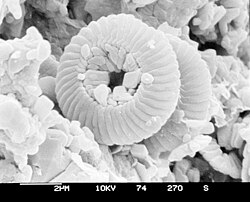
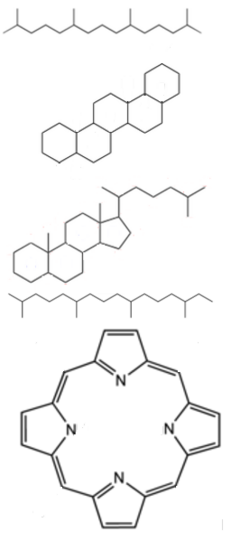
大気成分とアグノスティックな指標
惑星の大気中に存在する特定のガス(光合成色素や代謝ガスなど)は、遠隔地から生命を検知するための重要な手がかりです。また、地球上の生命とは異なる未知の化学系を持つ生命を想定した「アグノスティック(不可知論的)バイオシグネチャー」の研究も進んでいます。
![A Life Detection Ladder summarizing measurable traits associated with living systems, ordered by how strongly they may indicate extant life. The framework, inspired by lessons from Viking and later missions, links biological features with the types of measurements that could support a confident life-detection claim.[57]](/images/68/2f/682fe87a846704ceaf156c672fff4a4e52052d22920ea964f6e24d34356e6dcd.jpg)
太陽系内における生命探査の現状
私たちの近隣にある天体では、具体的なバイオシグネチャーの候補がいくつか見つかっていますが、その解釈には慎重な検証が必要です。
火星:メタンと酸素の謎
火星の大気からはオゾンや酸素が検出されていますが、これらは二酸化炭素の光分解という非生物的な化学反応で説明がつくため、現在は有効なバイオシグネチャーとは見なされていません。一方で、メタンの検出は注目されており、生物由来の可能性が議論されています。
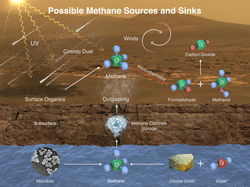
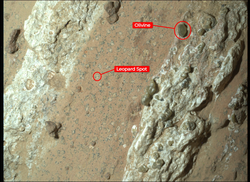
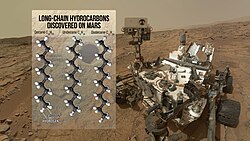
また、ジェゼロクレーターで発見された「Cheyava Falls」のような構造や、ゲールクレーターで検出された長鎖炭化水素(細胞膜の主成分となる脂肪酸)などは、微生物生命の痕跡である可能性が検討されています。
![Some researchers suggested that these microscopic structures on the Martian ALH84001 meteorite could be fossilized bacteria.[114][115]](/images/f9/3f/f93fce9560728501410c31918f02035a64419cae82704f77e768e1d46dd78335.jpg)
金星と氷の衛星
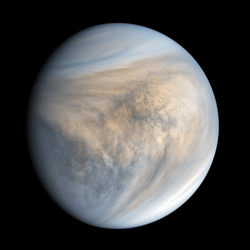
金星の雲層からは、ホスフィン、アンモニア、オゾンといった候補物質が報告されており、過酷な環境下での生命の可能性が模索されています。
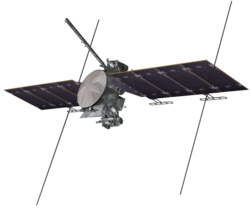
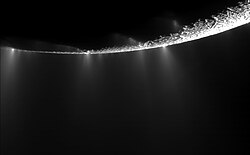
さらに、エウロパやエンケラドゥスのような氷の衛星は、内部に液体の海を持つため、非常に有望な探査対象です。エンケラドゥスから噴出する水蒸気プルームの分析や、エウロパ・クリッパーなどのミッションを通じて、生命維持に必要な有機物の存在が調査されています。
系外惑星における生命検出の課題
太陽系外の惑星では、大気スペクトル分析を用いて生命の兆候を探ります。例えば、メタンが検出され、かつ主星がG型やK型星である場合、それは有力なバイオシグネチャーと解釈される可能性があります。
![Biogenic methane production is the main contributor to the methane flux coming from the surface of Earth. Methane has a photochemical sink in the atmosphere but will build up if the flux is high enough. If there is detectable methane in the atmosphere of another planet, especially with a host star of G or K type, this may be interpreted as a viable biosignature.[48]](/images/c4/2d/c42d94568fc6f60c2b19dba9dada555ea2d3b987a822c5126f8983874c513c1a.png)
しかし、最大の課題は「偽陽性(False Positive)」です。生物がいないにもかかわらず、化学反応によって生命が存在するように見える現象が起こり得ます。例えば、酸素が検出されても、それが光化学反応によるものである可能性を排除しなければなりません。
![False positive mechanisms for oxygen on a variety of planet scenarios. The molecules in each large rectangle represent the main contributors to a spectrum of the planet's atmosphere. The molecules circled in yellow represent the molecules that would help confirm a false positive biosignature if they were detected. Furthermore, the molecules crossed out in red would help confirm a false positive biosignature if they were not detected. Cartoon adapted from Victoria Meadows' 2018 oxygen as a biosignature study.[12]](/images/54/cf/54cfb4b52e0e74426cb0d4662d68200739b6917b07fd9c6e2697b66e334e5618.png)
Key Facts
- 厳格な定義:バイオシグネチャーとは、非生物的な原因をすべて排除し、生物学的プロセスでしか説明できない現象のこと。
- 多角的な指標:形態(化石)、化学組成(ホモキラリティ)、大気ガス(メタン、ホスフィン等)など多岐にわたる。
- 偽陽性のリスク:酸素などのガスは非生物的な化学反応でも生成されるため、環境全体のコンテキスト分析が不可欠。
- 重点探査領域:火星の地表、金星の雲層、エウロパやエンケラドゥスの内部海が主要なターゲット。
バイオシグネチャーの分類まとめ
| カテゴリー | 具体的な指標・例 | 検出方法 |
|---|---|---|
| 形態学的 | 細胞構造、微生物化石 | 顕微鏡観察、地質サンプル分析 |
| 化学的 | ホモキラリティ、特定の同位体比、脂肪酸 | 質量分析、分光分析 |
| 大気成分 | メタン、酸素、ホスフィン、アンモニア | 遠隔分光観測(スペクトル分析) |
| アグノスティック | 未知の複雑な分子パターン | 高度な統計的・化学的解析 |
Frequently Asked Questions
酸素が見つかれば、すぐに生命がいると言えるのでしょうか?
いいえ。酸素は光化学反応(二酸化炭素の分解など)によって非生物的に生成されることがあるため、他のガスとの組み合わせや惑星環境を総合的に判断し、非生物的な要因を排除する必要があります。
バイオマーカーとバイオシグネチャーの違いは何ですか?
バイオマーカーは主に特定の生物に由来する具体的な有機化合物(化石など)を指しますが、バイオシグネチャーはより広義で、物質だけでなく現象やパターンまで含み、かつ非生物的要因を排除したという科学的結論までを含む概念です。
火星でメタンが見つかっているのはなぜ重要なのですか?
地球においてメタンの大部分は生物(微生物)によって生成されているためです。火星でメタンが検出され、それが地質学的な反応で説明できない場合、地下に微生物が存在する強力な証拠となります。
「アグノスティックなバイオシグネチャー」とは何ですか?
地球上の生命(DNAやタンパク質ベース)とは全く異なる化学組成を持つ生命を想定した指標のことです。特定の物質を探すのではなく、「自然界では偶然に起こりにくい複雑な構造」などの普遍的な生命の特性を探るアプローチです。
References
- Gillen, Catherine; Jeancolas, Cyrille; McMahon, Sean; Vickers, Peter (2023-11-01). "The Call for a New Definition of Biosignature". Astrobiology. 23 (11): 1228–1237. :2023AsBio..23.1228G. :10.1089/ast.2023.0010. :20.500.11820/c24b73d5-6628-487e-aee6-6f9d6ddb0f15. 1531-1074. 37819715.
- Lovelock, J. E. (August 1965). "A Physical Basis for Life Detection Experiments". Nature. 207 (4997): 568–570. :1965Natur.207..568L. :10.1038/207568a0. 1476-4687. 5883628.
- Lederberg, Joshua (July 1965). "Signs of Life: Criterion-System of Exobiology". Nature. 207 (4992): 9–13. :1965Natur.207....9L. :10.1038/207009a0. 0028-0836. 5866540.
- Rho, Joon H.; Bauman, A. J.; Boettger, Heinz G.; Yen, Teh Fu (January 1973). "A search for porphyrin biomarkers in nonesuch shale and extraterrestrial samples". Space Life Sciences. 4 (1): 69–77. :1973SLSci...4...69R. :10.1007/BF02626343. 0169-6149. 4713863.
- "An Exobiological Strategy for Mars Exploration". NASA Technical Reports Server. 1995-04-01.
- Des Marais, David J.; Allamandola, Louis J.; Benner, Steven A.; Boss, Alan P.; Deamer, David; Falkowski, Paul G.; Farmer, Jack D.; Hedges, S. Blair; Jakosky, Bruce M.; Knoll, Andrew H.; Liskowsky, David R.; Meadows, Victoria S.; Meyer, Michael A.; Pilcher, Carl B.; Nealson, Kenneth H. (June 2003). "The NASA Astrobiology Roadmap". Astrobiology. 3 (2): 219–235. :2003AsBio...3..219D. :10.1089/153110703769016299. 1531-1074. 14577870.
- Catling, David C.; Krissansen-Totton, Joshua; Kiang, Nancy Y.; Crisp, David; Robinson, Tyler D.; DasSarma, Shiladitya; Rushby, Andrew J.; Del Genio, Anthony; Bains, William; Domagal-Goldman, Shawn (June 2018). "Exoplanet Biosignatures: A Framework for Their Assessment". Astrobiology. 18 (6): 709–738. :1705.06381. :2018AsBio..18..709C. :10.1089/ast.2017.1737. 1531-1074. 6049621. 29676932.
- NASA Astrobiology Strategy 2015 Archived 2016-12-22 at the .(PDF), NASA.
- Frank, Adam (31 December 2020). "A new frontier is opening in the search for extraterrestrial life - The reason we haven't found life elsewhere in the universe is simple: We haven't looked until now". . Retrieved 1 January 2021.
- Seager, Sara; Schrenk, Matthew; Bains, William (January 2012). "An Astrophysical View of Earth-Based Metabolic Biosignature Gases". Astrobiology. 12 (1): 61–82. :2012AsBio..12...61S. :10.1089/ast.2010.0489. 1531-1074. 22269061.
📸 フォトギャラリー