紀元前4世紀に活躍した哲学者アリストテレスが提唱した「物理学」は、現代の物理学とは大きく異なり、自然界のあらゆる変化を包括的に説明しようとする自然哲学の一形態でした。彼は、生物か無生物か、あるいは地上か天上かに関わらず、すべての自然体に共通する「変化の一般原則」を確立することを目指しました。
彼にとっての物理学とは、単なる物体の運動だけでなく、サイズの増減(量的変化)、性質の変容(質的変化)、そして生成と消滅(実体的変化)までを含む広大な領域でした。さらに、現代では心理学や生物学、解剖学に分類される分野までもが、この物理学的な思考の枠組みの中に組み込まれていました。
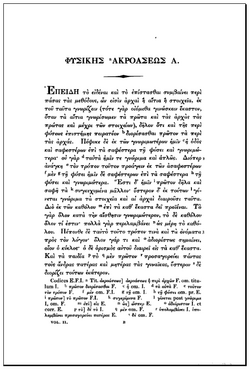
Key Facts
- 宇宙構造:地球を中心とし、その周囲を同心円状の天球が囲む構造。
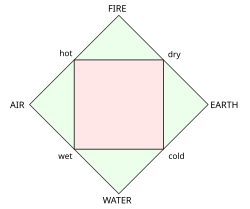
- 構成要素:地上は「地・水・火・空気」の四元素で成り立ち、天上は不変の「エーテル」で構成される。
- 自然運動:物質はそれぞれの「本来あるべき場所」へ戻ろうとする性質を持つ(例:土と水は下へ、火と空気は上へ)。
- 四原因説:あらゆる変化は「質料因」「形相因」「作用因」「目的因」の4つの要因で説明できる。
- 真空の否定:速度が無限大になってしまうため、真空は存在し得ないと主張した。
宇宙の構造と物質の性質
地上の四元素と天上のエーテル
アリストテレスは、宇宙を二つの異なる領域に分けて考えました。私たちが住む地上界は、地、水、空気、火という4つの元素から構成されており、これらは常に変化し、やがて朽ち果てる性質を持っています。一方で、月より上の天上界は、不変で永遠なる第五元素エーテルで満たされていると考えました。
天球の階層構造
宇宙のモデルは、地球を中心とした同心円状の球体として描かれました。内側から月、水星、金星、太陽、火星、木星、土星の順に天球が配置され、さらにその外側には固定星の圏域、そしてすべてを動かす「第一不動の動者」が存在するとされました。この完璧な円運動を維持するため、彼は複雑な球体の組み合わせ(最大で44〜55個)を想定していました。
![Peter Apian's 1524 representation of the universe, heavily influenced by Aristotle's ideas. The terrestrial spheres of water and earth (shown in the form of continents and oceans) are at the center of the universe, immediately surrounded by the spheres of air, and then fire, where meteorites and comets were believed to originate. The surrounding celestial spheres from inner to outer are those of the Moon, Mercury, Venus, Sun, Mars, Jupiter, and Saturn, each indicated by a planet symbol. The eighth sphere is the firmament of fixed stars, which include the visible constellations. The precession of the equinoxes caused a gap between the visible and notional divisions of the zodiac, so medieval Christian astronomers created a ninth sphere, the Crystallinum which holds an unchanging version of the zodiac.[4][5] The tenth sphere is that of the divine prime mover proposed by Aristotle (though each sphere would have an unmoved mover). Above that, Christian theology placed the "Empire of God". What this diagram does not show is how Aristotle explained the complicated curves that the planets make in the sky. To preserve the principle of perfect circular motion, he proposed that each planet was moved by several nested spheres, with the poles of each connected to the next outermost, but with axes of rotation offset from each other. Though Aristotle left the number of spheres open to empirical determination, he proposed adding to the many-sphere models of previous astronomers, resulting in a total of 44 or 55 celestial spheres.](/images/95/ed/95ed2b52b47063be53af395c59c0e7faa41218cc18744f2fee71261d4b57afed.png)
運動の理論と物理的法則
自然運動と不自然な運動
物質には、その構成元素に基づいた「自然な運動」があると考えました。例えば、土や水は中心方向(下)へ、火や空気は外側(上)へ移動しようとします。この移動速度は、物体の重量と、それが浸かっている媒体(空気や水など)の密度によって決まるとされました。
![Aristotle's laws of motion. In Physics he states that objects fall at a speed proportional to their weight and inversely proportional to the density of the fluid they are immersed in. This is a correct approximation for objects in Earth's gravitational field moving in air or water.[3]](/images/f5/16/f5165f5c4318c9ef66b66e3bca16b7f28290f3a42b0f9de0ce50d93d5c601e84.webp)
一方で、外部から力を加えられて起こる「不自然な運動(強制運動)」については、力が加わり続けている間だけ運動が維持されると考えました。例えば、放たれた矢が飛び続ける理由について、彼は矢を押し出す空気が次々と後ろから押し上げているという説を唱え、運動の継続性を説明しようとしました。
空間と真空への視点
アリストテレスは「場所(topos)」を、ある物体が別の物体に包まれている際の接触面として定義しました。また、もし真空が存在すれば、抵抗がないため物体の速度が無限に達してしまうと考え、真空の存在を論理的に否定しました。
万物を説明する「四原因説」
アリストテレスは、ある事物が「なぜそうなったのか」を説明するために、4つの原因を提示しました。
- 質料因(Material Cause): その物が何からできているか(例:彫像におけるブロンズ)。
- 形相因(Formal Cause): その物の本質や設計図、定義(例:彫像の形や比率)。
- 作用因(Efficient Cause): その物を変化させた直接的な力や主体(例:彫像を作る彫刻家)。
- 目的因(Final Cause): その物が存在する目的やゴール(例:崇拝のために作られたという目的)。
この目的論的な考え方は生物学にも適用され、胚が成体へと成長するのは「成体の形態」という目的があるからだと説明されました。
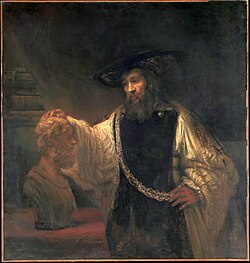
後世への影響と科学的転換
中世の批判と発展
アリストテレスの体系は長らく支配的でしたが、中世のイスラム圏の学者たちによって疑問が呈されました。イブン・アルハイサムは「場所」の幾何学的定義を批判し、アル・バグダーディーは、一定の力が加わり続けると速度が増す(加速度)という、後のニュートン力学に通じる概念を指摘しました。また、ジャン・ブリードンは「インペトゥス(衝動)」理論を提唱し、慣性の概念への道を開きました。
近代科学による塗り替え
17世紀の科学革命において、ガリレオ・ガリレイらはアリストテレスの定性的なアプローチを否定し、数学的な定量分析を導入しました。アリストテレスが主張した「重いものほど速く落ちる」という説は、真空状態では質量に関わらず同じ速度で落下するという事実によって覆されました。これは1971年にアポロ計画のデヴィッド・スコット飛行士が月面でハンマーと羽を同時に落とした実験によっても証明されています。
| 著作名(日本語) | ラテン語名 | 主な内容 |
|---|---|---|
| 物理学 | Physica | 自然の変化、運動、時間、場所の分析 |
| 天球について | De Caelo | 宇宙の構造とエーテルの性質 |
| 生成と消滅について | De Generatione et Corruptione | 物質の変化と四元素の相互変換 |
| 魂について | De Anima | 知覚、思考、生命の原理(心理学) |
| 動物の生成について | De Generatione Animalium | 生物の発生と四原因の適用 |
Frequently Asked Questions
アリストテレスの物理学と現代の物理学の最大の違いは何ですか?
最大の違いは、アリストテレスが「目的(なぜそうなるのか)」という定性的な説明を重視したのに対し、現代物理学は数学的な法則と定量的なデータに基づき、「どのように起こるのか」というメカニズムを解明しようとする点にあります。
「エーテル」とはどのような物質だと考えられていたのですか?
地上の四元素(地・水・火・空気)とは異なり、変化せず、朽ちることのない純粋な物質とされました。天上の天球はこのエーテルで構成されており、完璧な円運動を行う性質を持つと考えられていました。
なぜアリストテレスは真空を否定したのですか?
彼は、物体の運動速度が媒体の密度に反比例すると考えました。もし密度がゼロの真空が存在すれば、速度は無限大になってしまい、物理的に不可能であると結論付けたためです。
「四原因説」を具体例で説明するとどうなりますか?
例えば「木製のテーブル」の場合、木材が質料因、テーブルという設計や形状が形相因、大工さんの作業が作用因、そして物を置くという用途が目的因となります。これら4つが揃って初めて、その物が成立すると考えました。
アリストテレスの理論は完全に間違っていたということですか?
現代の視点からは誤りが多く見えますが、彼は詳細な観察とデータ収集(解剖など)に基づいた体系的な自然科学の基礎を築きました。また、彼の分類学や論理学的なアプローチは、後の科学的手法の発展に大きな影響を与えました。
References
- Lang, H.S. (2007). The Order of Nature in Aristotle's Physics: Place and the Elements. Cambridge University Press. p. 290. .
- White, Michael J. (2009). "Aristotle on the Infinite, Space, and Time". Blackwell Companion to Aristotle. p. 260.
- Rovelli, Carlo (2015). "Aristotle's Physics: A Physicist's Look". Journal of the American Philosophical Association. 1 (1): 23–40. :1312.4057. :10.1017/apa.2014.11. 44193681.
- "Medieval Universe".
- History of Science
- "Physics of Aristotle vs. The Physics of Galileo". Archived from the original on 11 April 2009. Retrieved 6 April 2009.
- "hep.fsu.edu" (PDF). Retrieved 26 March 2007.
- "Aristotle's physics". Retrieved 6 April 2009.
- Aristotle, .
- Sorabji, R. (2005). The Philosophy of the Commentators, 200-600 AD: Physics. G – Reference, Information and Interdisciplinary Subjects Series. Cornell University Press. p. 352. . 2004063547.
📸 フォトギャラリー