現代社会において、アルミニウムほど身近で汎用性の高い金属は少ないでしょう。飲料缶から航空機、建築資材に至るまで、その軽量さと耐久性は多くの産業を支えています。銀白色の光沢を持つこの元素は、地球上に豊富に存在しながらも、抽出には高度な化学プロセスを必要とする興味深い特性を持っています。
主要な事実(Key Facts)
- 原子番号13のpブロック元素であり、周期表の第13族(ホウ素族)に属します。
- 軽量かつ高強度であり、密度は2.699 g/cm³(20 °C)と非常に低いです。
- 耐食性に優れ、表面に形成される酸化皮膜が内部の腐食を防ぎます。
- リサイクル効率が極めて高く、環境負荷を抑えた再利用が可能です。
- 主要鉱石はボーキサイトであり、バイヤー法とホール・エルー法を経て精錬されます。
アルミニウムの物理的・化学的性質
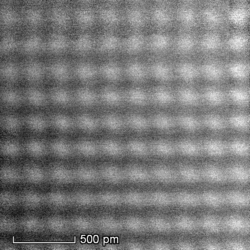
アルミニウムは、標準状態で固体であり、融点は660.32 °C、沸点は2470 °Cです。結晶構造は面心立方格子(fcc)を採用しており、これにより優れた延性と展性を備えています。また、熱伝導率(237 W/(m·K))と電気伝導率が高いため、放熱材や電線としても重宝されています。

化学的には、主に+3の酸化状態で存在します。空気中にさらされると即座に薄い酸化アルミニウム(アルミナ)の層を形成し、これが保護膜となってさらなる酸化を抑制します。この性質が、塗装なしでも屋外で使用できる高い耐食性の根源となっています。
原子構造と同位体
アルミニウムの標準原子量は26.9815384であり、自然界に存在する同位体は安定同位体である27Alのみ(存在比100%)です。電子配置は [Ne] 3s² 3p¹ となり、最外殻に3つの電子を持つため、化学反応においてこれらの電子を放出しやすい傾向にあります。
歴史的背景と名称の変遷
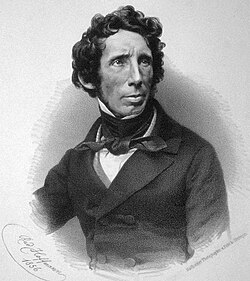
アルミニウムの存在は1782年にアントワーヌ・ラヴォアジエによって予言され、1824年にハンス・クリスティアン・エルステッドによって発見されました。その後、フリードリヒ・ヴェーラーが金属状態のアルミニウムを詳細に記述し、近代的な精錬技術への道が開かれました。
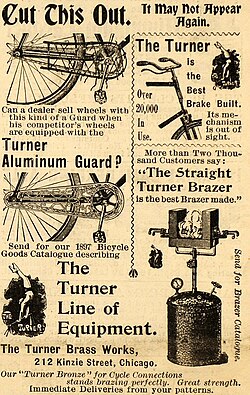
名称に関しては、英語圏で「aluminium」と「aluminum」の2つの綴りが共存しています。後者は主に米国やカナダで用いられ、前者はIUPAC(国際純正・応用化学連合)によって国際標準として認められています。かつては抽出が困難で非常に高価だったため、貴金属のような扱いを受けていた時代もありました。
生産プロセスと産業的応用
アルミニウムは単体では自然界に存在せず、主にボーキサイトという鉱石から抽出されます。生産工程は大きく分けて2つの段階に分かれています。まず「バイヤー法」でボーキサイトから純粋な酸化アルミニウム(アルミナ)を取り出し、次に「ホール・エルー法」という電気分解プロセスを用いて金属アルミニウムを精製します。

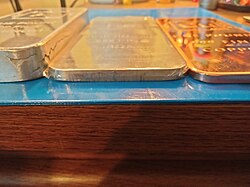
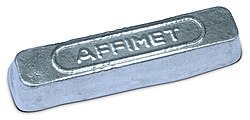
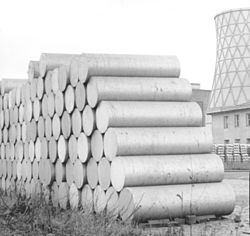
精錬されたアルミニウムは、インゴット(鋳塊)やビレット(押出材)の形態で供給され、用途に応じて様々な合金へと加工されます。
幅広い活用分野
その特性を活かし、以下のような多岐にわたる分野で利用されています。
- 輸送機器: 軽量化による燃費向上を目的とした自動車ボディや航空機機体。
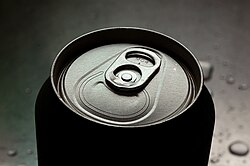
- 包装材: 遮光性と気密性に優れた飲料缶やアルミ箔。
- 建築・土木: 窓枠や外壁材などの構造部材。
- 電子部品: ヒートシンクや電解コンデンサ。

リサイクルと環境への影響
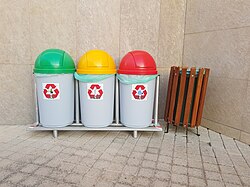
アルミニウムの最大の特徴の一つは、リサイクルに要するエネルギーが新地金を作る場合のわずか数パーセントで済むことです。そのため、世界中で回収システムが整備されており、持続可能な資源循環のモデルとなっています。
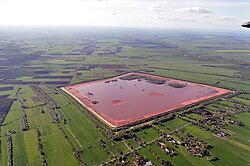
一方で、生産過程で発生する「赤泥(レッドマッド)」などの廃棄物処理は環境上の課題となっており、適切な管理施設での保管が求められています。
生物学的影響と安全性
アルミニウムは環境中に広く存在し、皮膚や呼吸器を通じて人体に吸収されることがあります。特に水酸化アルミニウムなどの化合物は、ワクチンのアジュバント(免疫補助剤)として利用されるなど、医療分野でも活用されています。
![Schematic of aluminium absorption by human skin.[188]](/images/6b/f5/6bf566ac220399280f486bd70b2ae6698edc09605c6dfc8ba666621afa20619b.jpg)
人体への吸収経路は、細胞間隙を通るパラセルラー経路や、能動輸送、エンドサイトーシスなど複数のルートが存在します。一般的に低毒性とされていますが、過剰な蓄積が健康に与える影響については、現在も研究が続けられています。
![There are five major aluminium forms absorbed by human body: the free solvated trivalent cation (Al3+(aq)); low-molecular-weight, neutral, soluble complexes (LMW-Al0(aq)); high-molecular-weight, neutral, soluble complexes (HMW-Al0(aq)); low-molecular-weight, charged, soluble complexes (LMW-Al(L)n+/−(aq)); nano and micro-particulates (Al(L)n(s)). They are transported across cell membranes or cell epi-/endothelia through five major routes: (1) paracellular; (2) transcellular; (3) active transport; (4) channels; (5) adsorptive or receptor-mediated endocytosis.[188]](/images/7f/70/7f70166972999412fddd54848654cd5c547beb71ed64b80aa910b3997aaf4009.jpg)
化学的特性のまとめ
アルミニウムの化学的挙動はpH値に強く依存します。酸性および塩基性の両方で溶解する両性金属としての性質を持ち、水溶液中ではpHに応じて異なる形態の錯体を形成します。
![Aluminium hydrolysis as a function of pH. Coordinated water molecules are omitted.[51]](/images/f0/b3/f0b3be89e420551d6ae40717bd910ed6c8d7a3995f2f697bfa55f4830b011698.png)
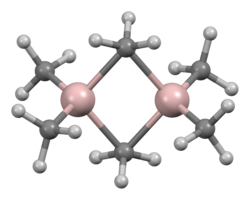
また、有機アルミニウム化合物(トリメチルアルミニウムなど)は、化学合成における重要な触媒や原料として利用されており、高度な工業化学を支えています。
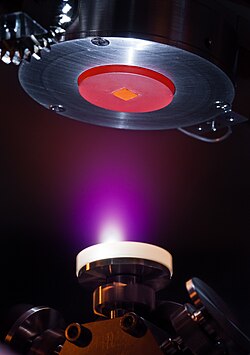
さらに、最先端の技術ではレーザー堆積法を用いてアルミナ(酸化アルミニウム)を基板上に形成させるなど、ナノレベルでの材料制御が進んでいます。
アルミニウムの基本データ一覧
| 項目 | 数値・特性 |
|---|---|
| 原子番号 / 原子量 | 13 / 26.982 |
| 融点 / 沸点 | 660.32 °C / 2470 °C |
| 密度 (20 °C) | 2.699 g/cm³ |
| 結晶構造 | 面心立方格子 (fcc) |
| モース硬度 | 2.75 |
| 主な酸化状態 | +3 |
Frequently Asked Questions
アルミニウムとアルミナムの違いは何ですか?
これは単なる綴りと発音の違いであり、指している元素は同一です。「aluminium」が国際的な標準(IUPAC)であり、「aluminum」は主に北米で使われる表記です。
なぜアルミニウムは錆びにくいのですか?
アルミニウムは反応性が高い金属ですが、空気に触れると瞬時に表面に非常に緻密な酸化アルミニウム(アルミナ)の薄い膜を作ります。この膜がバリアとなり、内部まで酸素が浸透するのを防ぐため、実質的に錆びにくい性質を持ちます。
ボーキサイトとは何ですか?
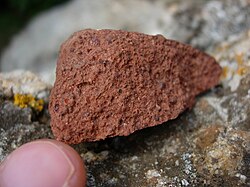
アルミニウムの主要な原料となる鉱石です。酸化アルミニウムを含む鉱物で構成されており、鉄分などの不純物が含まれているため、通常は赤褐色をしています。
アルミニウムのリサイクルにはどのようなメリットがありますか?
新しくボーキサイトからアルミニウムを精錬する場合に比べて、リサイクルによる生産はエネルギー消費量を劇的に削減でき、二酸化炭素の排出量も大幅に抑えられるため、環境負荷が非常に低くなります。
人体への影響について心配はありますか?
アルミニウムは日常的に食品や医薬品を通じて摂取されています。多くの健康な成人では適切に排泄されますが、腎機能が低下している場合などは蓄積しやすくなるため、医学的な視点から注意深く研究されています。
References
- Davy's 1812 written usage of the word aluminum was predated by other authors' usage of aluminium. However, Davy is often mentioned as the person who named the element; he was the first to coin a name for aluminium: he used alumium in 1808. Other authors did not accept that name, choosing aluminium instead. See for more details.
- Most other metals have greater standard atomic weights: for instance, that of iron is 55.845; copper 63.546; lead 207.2. which has consequences for the element's properties (see )
- The two sides of aluminium foil differ in their luster: one is shiny and the other is dull. The difference is due to the small mechanical damage on the surface of dull side arising from the technological process of aluminium foil manufacturing. Both sides reflect similar amounts of visible light, but the shiny side reflects a far greater share of visible light whereas the dull side almost exclusively light. Both sides of aluminium foil serve as good (approximately 86%) of and an excellent reflector (as much as 97%) of medium and far radiation.
- No elements with odd atomic number have more than two stable isotopes, while even-numbered elements from oxygen to lead (atomic numbers 8 to 82) all have more than two. See for more details.
- In fact, aluminium's electropositive behavior, high affinity for oxygen, and highly negative are all better aligned with those of , , , and , which like aluminium have three valence electrons outside a noble gas core; this series shows continuous trends whereas those of group 13 is broken by the first added d-subshell in gallium and the resulting and the first added f-subshell in thallium and the resulting .
- These should not be considered as [AlF6]3− complex anions as the Al–F bonds are not significantly different in type from the other M–F bonds.
- Such differences in coordination between the fluorides and heavier halides are not unusual, occurring in SnIV and BiIII, for example; even bigger differences occur between and .
- Abundances in the source are listed relative to silicon rather than in per-particle notation. The sum of all elements per 106 parts of silicon is 2.6682×10¹⁰ parts; aluminium comprises 8.410×10⁴ parts.
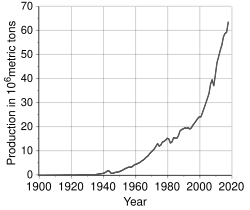
- Compare annual statistics of aluminium and copper production by USGS.
- The spelling alumine comes from French, whereas the spelling alumina comes from Latin.
📸 フォトギャラリー