紀元前2334年頃、メソポタミアの地にアッカド帝国という巨大な権力が誕生しました。それまでの都市国家が乱立していた時代を終わらせ、広大な地域を一つの統治下に置いたこの国家は、人類にとって「世界初の帝国」としての先駆けとなりました。アッカド帝国は、軍事的な征服だけでなく、言語や行政システムの統一を通じて、後の文明に多大な影響を与えました。
帝国の版図は、現在のイラク、シリア、トルコ、イラン、クウェートにまたがる広大な領域に及びました。特に初期の拡大期には、シュメールの都市国家を次々と併合し、中央集権的な体制を確立していきました。
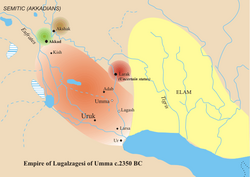
Key Facts
- 成立時期: 紀元前2334年頃から紀元前2154年頃まで(中期年代説)。
- 創始者: サルゴン大王による征服活動で帝国が成立。
- 公用語: アッカド語が正統な言語として用いられ、シュメール語は儀礼や学術的な用途で保持された。
- 統治形態: 皇帝(王)による帝国君主制。
- 崩壊要因: グティ人の侵入や、深刻な干ばつなどの気候変動が影響したとされる。
帝国の興隆と歴代の統治者
サルゴン大王による基盤構築
アッカド帝国の礎を築いたのは、伝説的な王サルゴンです。彼は強力な軍事力を用いてシュメールの諸都市を制圧し、アッカドを首都とする広大な帝国を創設しました。サルゴンの統治は、単なる武力支配に留まらず、行政の効率化や交易路の確保によって帝国の安定を図りました。
![Sargon on his victory stele, with a royal hair bun, holding a mace and wearing a flounced royal coat on his left shoulder with a large belt (left), followed by an attendant holding a royal umbrella.[51][52] The name of Sargon in cuneiform ("King Sargon") appears faintly in front of his face.[51][53] Louvre Museum.](/images/78/ad/78add91556645792ce91dabfdee6a383e33f5af6f86b2bcea67aae724353237a.jpg)
サルゴンの側近や官僚たちは、帝国の隅々まで統制を及ぼすための組織的な管理体制を構築していました。
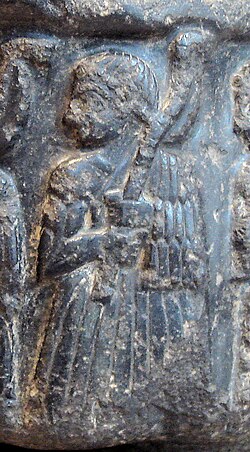
しかし、サルゴンの治世後半には各地で反乱が頻発し、帝国の維持には絶え間ない軍事行動が必要となりました。シュメールの都市国家との激しい衝突は、多くの犠牲者を出す血塗られた歴史でもありました。
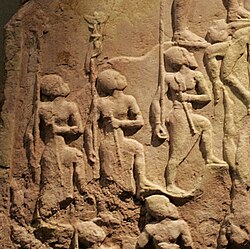
![Prisoners escorted by a soldier, on a victory stele of Sargon of Akkad, circa 2300 BC.[60][61] The hairstyle of the prisoners (curly hair on top and short hair on the sides) is characteristic of Sumerians, as also seen on the Standard of Ur.[62] Louvre Museum.](/images/1c/d3/1cd3be6b4e286a610a8bb73970f7992e343e3f61d5657c8ce10d1d3790cf120f.jpg)
後継者たちと軍事的拡大
サルゴンの後を継いだリムシュやマニシュトゥシュの時代には、反乱の鎮圧と領土の維持が主眼となりました。特にリムシュの時代には、アダブやウル、ラガシュといった都市での激戦が繰り広げられ、数万人規模の死傷者が出たことが記録されています。
![Akkadian soldiers slaying enemies, circa 2300 BC, possibly from a Victory Stele of Rimush.[65]](/images/77/86/7786bd0e4c138273ccdf40dab1f9fe8a3630aecf2c4193894bdf8f388c5b845a.jpg)
ナラム・シンによる絶頂期
帝国の最盛期を築いたのが、サルゴンの孫であるナラム・シンです。彼はザグロス山脈のルルビ族を撃破するなど、さらなる領土拡大を達成しました。ナラム・シンは自らを「神」として位置づけ、王の権威を絶対的なものへと高めました。これは、それまでの王が神の代理人であったこととは異なる、極めて特異な権力形態でした。
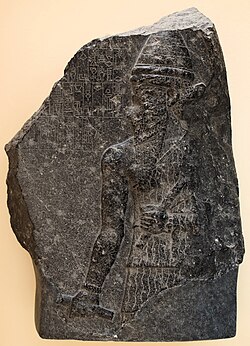
彼の勝利を記念して建てられた石碑には、神性の象徴である角付きの兜を被ったナラム・シンの姿が描かれており、他の人物よりも大きく表現されることでその超越性が強調されています。
![Victory Stele of Naram-Sin, celebrating victory against the Lullubi from Zagros 2260 BC. He is wearing a horned helmet, a symbol of divinity, and is also portrayed in a larger scale in comparison to others to emphasize his superiority.[69] Brought back from Sippar to Susa as war prize in the 12th century BC.](/images/27/a9/27a987e9c6df9cc3c2f61e300957ca5d603e62488efb0a360db9b3a7bf8fa027.jpg)
また、テル・ブラクなどの拠点に宮殿を建設し、帝国の威信を内外に示しました。
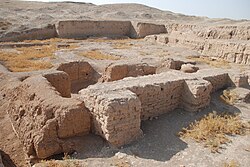
ナラム・シンの軍隊は高度な訓練を受けており、組織的な戦術で敵を圧倒しました。
文化・経済と国際交流
芸術と技術の進化
アッカド時代の芸術は、それまでの様式よりも写実的な表現へと進化しました。特に金属工芸や彫刻において、人物の表情や筋肉の動きを詳細に捉える傾向が見られます。
![Bronze head of an Akkadian ruler, discovered in Nineveh in 1931, presumably depicting either Sargon or, more probably, Sargon's grandson Naram-Sin.[25][26]](/images/2d/30/2d30c3f7f958a65c461b4587d0767c311a2e5a12d17ad145df21351229cf5797.jpg)
また、円筒印章(シリンダー・シール)という、粘土板に転がして署名や封印とする道具が発展しました。これらには神話的な場面や王の権威を示す図像が精巧に刻まれていました。
![Cylinder seal of the scribe Kalki, showing Prince Ubil-Eshtar, probable brother of Sargon, with dignitaries (an archer in front, the scribe holding a tablet following the Prince, and two dignitaries with weapons).[53]](/images/c5/21/c5211a805e920b12ec443aa17e656f1f542a7441de731297ef359d0bb98425bd.jpg)
!["Cylinder Seal with King or God and Vanquished Lion" (Old Akkadian).[88] The Walters Art Museum.](/images/26/cb/26cb0a76c9f2e174361e636b58e5bfad010869966519e8c6f557e6044560cca1.jpg)
印章の中には、インダス文明(メルハ)との交流を示すバッファローなどの動物が描かれたものもあり、当時の広範な貿易ネットワークを物語っています。
![Impression of a cylinder seal of the time of Akkadian King Sharkalisharri (c. 2200 BC), with central inscription: "The Divine Sharkalisharri Prince of Akkad, Ibni-Sharrum the Scribe his servant". The long-horned buffalo is thought to have come from the Indus Valley, and testifies to exchanges with Meluhha (the Indus Valley civilization) in a case of Indus-Mesopotamia relations. Circa 2217–2193 BC. Louvre Museum.[95][96][97]](/images/dc/f1/dcf1d0cd42fb4fdcbf1c96267ae128757440fe17adb527ef287a60694eed175e.jpg)
広域貿易と経済圏
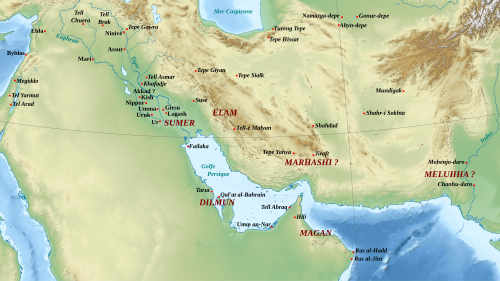
アッカド帝国は、地中海沿岸からインダス川流域まで、驚くほど広い範囲と交易を行っていました。地中海側からはムレックス貝(紫色の染料の原料)が輸入され、東方からは貴金属や宝石、木材などがもたらされました。
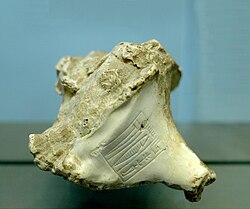
これらの交易ルートは、エラム、マガン、ディルムン、メルハといった遠方の地へと繋がっていました。
言語と文学の融合
帝国ではアッカド語が支配的な言語となりましたが、宗教的な儀礼や学問の世界ではシュメール語が尊重され続けました。この二言語の共存は、後のメソポタミア文化の基盤となりました。また、サルゴンの娘であるエンヘドゥアンナは、世界最古の署名入り文学作品を残した詩人兼女祭司として知られています。
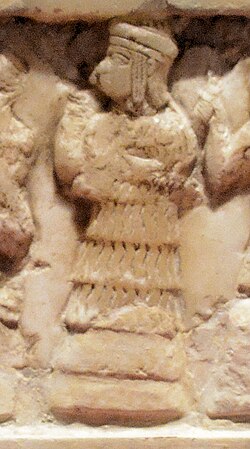
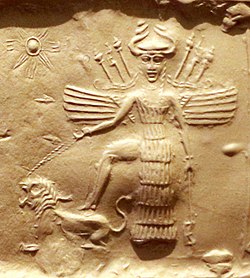
宗教面では、イシュタルなどの神々が崇拝され、それらは印章などの芸術作品にも頻繁に登場しました。
帝国の崩壊と終焉
シャルカリシャリ王の時代になると、帝国は内部的な混乱と外部からの圧力にさらされるようになります。特にザグロス山脈から侵入したグティ人による攻撃が致命的となりました。
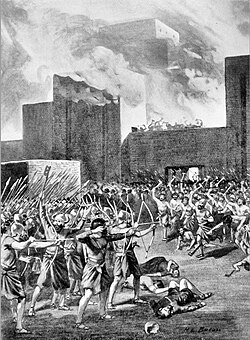
近年の研究では、政治的な要因だけでなく、深刻な干ばつや季節的な気候変動といった自然災害が農業生産を激減させ、帝国の崩壊を加速させたという説が有力視されています。これにより、中央集権的な統治能力が失われ、帝国は徐々に解体へと向かいました。
統治者の変遷まとめ
| 統治者 | 在位期間(紀元前) | 主な特徴・功績 |
|---|---|---|
| サルゴン | 2334–2279 | 帝国の創設者。シュメール諸都市を統合。 |
| リムシュ | 2279–2270 | 反乱の鎮圧と領土維持に奔走。 |
| マニシュトゥシュ | 2270–2255 | 帝国の安定化と行政整備。 |
| ナラム・シン | 2255–2218 | 最大版図を達成。自らを神格化。 |
| シャルカリシャリ | 2218–2193 | グティ人の侵入に直面し、衰退が始まる。 |
| シュトゥルル | 2168–2154 | 帝国最後の王。 |
帝国の崩壊後、メソポタミアはグティ人の支配時代を経て、再びシュメール文化が復興するウル第3王朝へと移行していきます。
Frequently Asked Questions
アッカド帝国が「世界初の帝国」と呼ばれるのはなぜですか?
それまでのメソポタミアは独立した都市国家の集まりでしたが、アッカド帝国は軍事力によってそれらを統合し、単一の権力者が広大な地域を統治する中央集権的な体制を初めて構築したためです。
アッカド語とシュメール語の違いは何ですか?
シュメール語はメソポタミア最古の言語であり、主に宗教や学術などの儀礼的な場面で使われました。一方、アッカド語はセム系言語であり、帝国の公用語として行政や日常的なコミュニケーションに広く用いられました。
ナラム・シン王が自分を「神」と称したのはなぜですか?
王の権威を絶対的なものにし、広大な領土内の多様な民族を効率的に統治するためと考えられています。これにより、政治的な忠誠心を宗教的な崇拝へと結びつけました。
帝国が滅亡した最大の原因は何だと考えられていますか?
グティ人などの外部勢力による侵攻という政治・軍事的要因に加え、近年の科学的分析では、深刻な干ばつなどの気候変動が食糧生産を破壊し、社会基盤を揺るがしたことが大きな要因であったとされています。
エンヘドゥアンナとはどのような人物ですか?
サルゴン大王の娘であり、最高位の女祭司を務めた人物です。彼女が執筆した賛歌などの文学作品は、歴史上最古の「作者が判明している文学」として非常に高く評価されています。
References
- : Akkad "(city of) Akkad"; : אַכַּד Akkad.
- Podany, Amanda H.; McGee, Marni (2005). The Ancient Near Eastern World. Oxford University Press. p. 60. .
- : Agade
- "Akkad". . HarperCollins. 1120411289.
- "Akkad". (Online). n.d.
- Mish, Frederick C., Editor in Chief. "Akkad" Webster's Ninth New Collegiate Dictionary. ninth ed. Springfield, MA: Merriam-Webster 1985. ).
- F Leo Oppenhiem – Ancient Mesopotamia
- Liverani (1993), p. 3. "The factual criticism is that empires existed even before Akkad: or more properly that the term and concept of 'empire' has been recently applied (on not worse grounds than in the case of Akkad) to other older cases, from the Uruk of the late-Uruk period to the Ebla of the royal archives, to the very state formations of the Sumerian south in the period called in fact 'proto-imperial'. In no case is the Akkad empire an absolute novelty [...] 'Akkad the first empire' is therefore subject to criticism not only as for the adjective 'first' but especially as for the noun 'empire'.
- Wall-Romana, Christophe (1990). "An Areal Location of Agade". Journal of Near Eastern Studies. 49 (3): 205–245. :10.1086/373442. 546244. 161165836.
- (1975), "Kish, Akkad and Agade", Journal of the American Oriental Society, 95 (3): 434–453, :10.2307/599355, 599355
- I.J. Gelb, "Sargon Texts from the Diyala Region", Materials for the Assyrian Dictionary, vol. 1, Chicago, 1961
- M. Molina, "Sargonic Cuneiform Tablets in the Real Academia de la Historia : The Carl L. Lippmann Collection", Real Academia de la Historia, 2014
📸 フォトギャラリー